10 Benefits of Agentic AI for Modern Software Platforms
For years, AI features in SaaS platforms have largely been assistive — summarizing information, drafting content, and answering questions. Agentic AI moves the experience from passive assistance to active execution. Instead of only telling a user how to resolve a support case, analyze a contract, or complete a business process, an AI agent can reason through the goal, break it into steps, use the proper tools, and take action to solve the issue.
For software vendors, agentic AI makes your platform feel more valuable, more adaptive, and more deeply embedded in users’ everyday workflows. For your customers, this means fewer manual steps, faster answers, better self-service, and more relevant guidance inside the tools they already use. From differentiating your product experience and increasing retention to expanding usage and supporting more premium features, this positions your platform to actually help customers complete work instead of simply generating content.
What Makes Agentic AI Different from Traditional AI Features?
Before we get into how agentic AI can supercharge your software platform, we need to differentiate between agentic AI and traditional AI. Traditional AI features typically require a user’s direct input that then generates a response (e.g. a user asks a question, the system returns an output). Inherently, these interactions are reactive instead of proactive.
Agentic AI can pursue a goal (with supervision), plan multiple steps, use external tools, interact with other systems, and adapt its behavior based on context. This is important to understand because for software vendors, AI agents aren’t just another layer of interface polish — they change how users interact with your platform. This is particularly relevant for engineering leaders, QA teams, and CTOs because they need to both:
- Evaluate whether the AI can produce useful outputs
- Evaluate whether the AI can safely participate in product workflows
Once an agent can retrieve data, make decisions, call APIs, trigger actions, or coordinate across tools, the product team has to think differently about design, testing, and release readiness.
We’ve covered how to build an AI agent in a previous article, so please read that if you’re interested in additional background and context.
Benefits of Adding Agentic AI
Instead of waiting for users to ask the right question, interpret the answer, and manually complete the next steps, agentic AI can actively move the workflow forward. Let’s take a closer look at some of the biggest benefits of incorporating it into your platform:
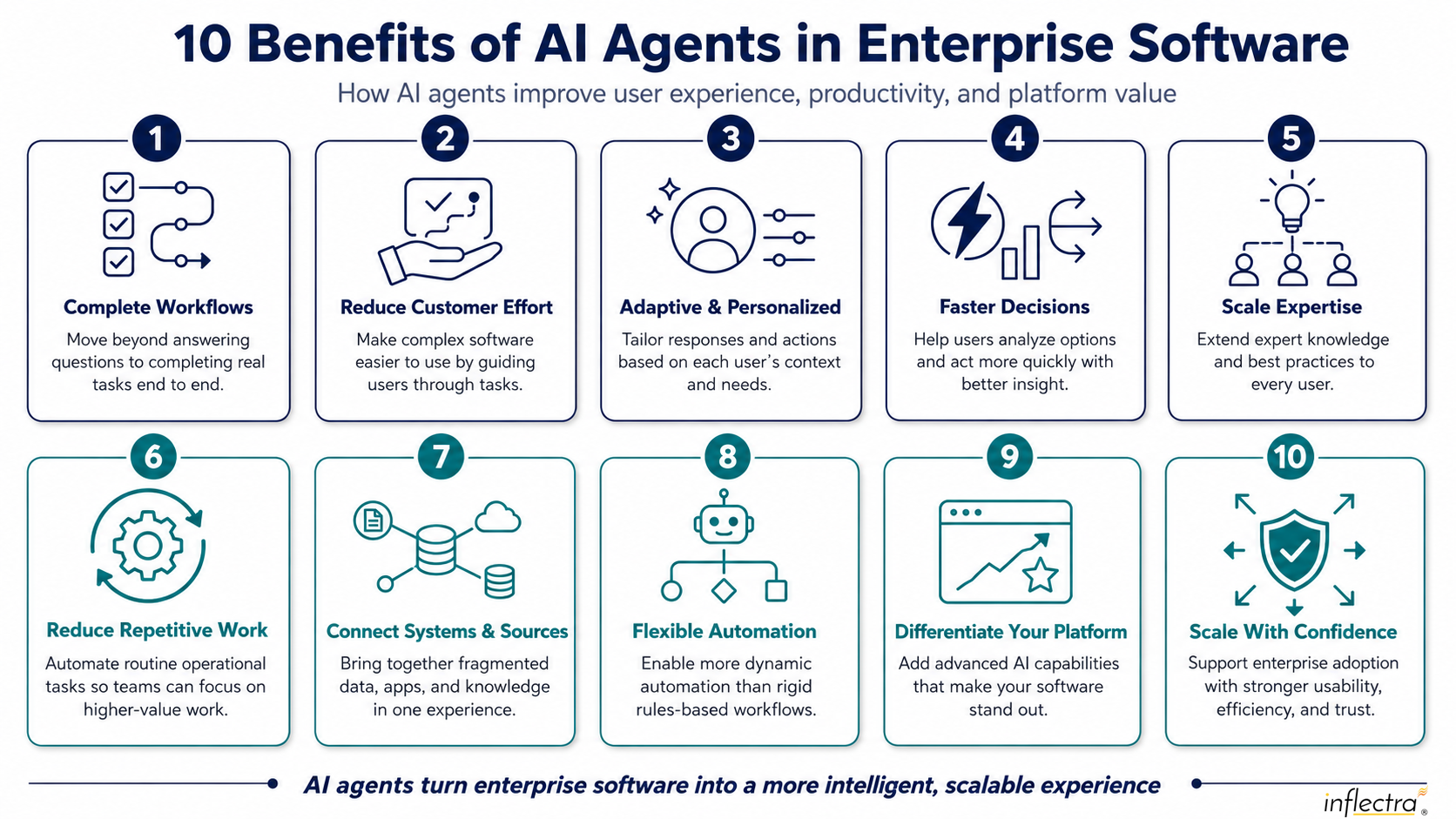
1. Completes Workflows Instead of Simply Answering Questions
One of the clearest advantages of agentic AI is that it can help users actually complete work rather than simply helping them understand the work. Answer-oriented features are still useful, but typically leave the user to translate that guidance into action. On the other hand, AI agents can close the gap between answer and outcome. This makes your platform feel less like a place where users search for answers and more like a system that helps them really get work done. Instead of being a conversational layer on top of the system, AI becomes part of the workflow itself, significantly enhancing your product experience and value proposition.
2. Reduces Customer Effort Inside Complex Software
Many software platforms become more powerful as they mature, but those additional capabilities often come with added complexity as well. Enterprise users may have to move through multiple screens, configure settings, search documentation, interpret dashboards, or coordinate across different teams just to complete a single task. Agentic AI helps reduce that effort by making complex workflows feel more guided and less fragmented. It can help surface and interpret the right information, guiding the user through the next best action (or even completing steps for the user directly). This is a major value-add for feature-rich platforms, developing a product that’s easier to adopt, expand, and use across different roles and skill levels.
3. Makes Software Feel More Adaptive & Personalized
Speaking of roles, agentic AI is especially adept at making systems feel more responsive to individualized context, history, and goals. Instead of delivering the same static workflow to every user, agents can tailor their guidance based on what each user is trying to accomplish. For vendors, this goes well beyond basic personalization, which historically relied on predefined rules and user segments. The adaptability that agentic AI offers immediately makes your software feel more relevant and less generic. The result is that customers aren’t simply receiving faster content, they’re getting a product experience that feels more aligned with how they work.
4. Helps Users Make Faster Decisions
Between the dashboards, reports, tickets, documents, alerts, and customer records of modern software platforms, users often have more data available than they can reasonably process. AI agents can work through all of this data, moving the user from information to informed decision faster than ever. Gathering context from various sources, identifying patterns, summarizing decision tradeoffs, and recommending potential next steps brings the most relevant information into the workflow. However, it’s critical to emphasize that the agent should not make every decision on behalf of the user — it should provide the most valuable information with contextual understanding so that humans can oversee the final decision (but do so more efficiently).

5. Scales Expertise Across Every User
In many software products, the best outcomes depend on how much relevant experience the user has. In other words, expert users know which reports to check, which settings to adjust, risks to keep an eye on, and steps that matter most. While newer or less frequent users may struggle to achieve the same results with the same tools, agentic AI scales that expertise and makes it available to everyone. Vendors can embed procedural knowledge, product context, and workflow guidance into the agent experience so that expert-level support is always available. For platforms that serve multiple roles or departments, AI agents can help each user interact with the tools in a way that fits their knowledge and the outcomes they need, resulting in higher adoption rates.
6. Reduces Repetitive Operational Work
AI has always been useful for repetitive tasks, but agentic systems expand the flexibility of automated workflows. Things like repeated interpretation, coordination, or follow-through often slow users down, even when these activities aren’t particularly strategic. Traditional rule-based automation can handle work when the steps are fixed and predictable, but struggles when tasks require context, involve variation, or benefit from judgment. Integrating agentic AI into your software means that customers end up spending less time on repetitive operational work and more time on higher-value tasks. Remember that for now, the strongest use cases for AI are not futuristic — they’re the common workflow bottlenecks that your users already know are painful.
7. Connects Fragmented Systems & Sources
Most modern software workflows don’t happen within a single system. From CRMs and analytics tools to support platforms, billing systems, documentation hubs, data warehouses, and internal knowledge bases, users often need to bounce between platforms. Agentic AI can act as a bridge between these fragmented systems, retrieving context, comparing information, calling tools, and taking action across connected environments for more coherent workflows. This significantly expands the role and capabilities of your platform, acting as a more intelligent control point, rather than one more isolated system that your users have to manage. This connected experience can be especially valuable for enterprise buyers, where workflows are often distributed across multiple systems, teams, and approval paths.
8. Enables More Flexible Automation Than Rules-Based Workflows
As we hinted at earlier, agentic AI enables significantly more flexible automation capabilities than traditional rules-based workflows. Rules can end up being brittle when the situation evolves, inputs are incomplete, or the user’s goal doesn’t fit a predefined path. Instead of relying on fixed rules, agentic AI can interpret and understand context, what the user is trying to achieve, break the task into steps, tailor its plan, and respond to unexpected conditions. This opens the door for workflows that were previously too variable to cleanly automate and often translates to AI features that feel both powerful and practical.
9. Differentiates Your Platform With Cutting-Edge Capabilities
In today’s software landscape, there’s a platform (or five) for every niche use case. Differentiation is key to gaining and retaining customers, but basic generative AI has already become relatively commonplace. Summaries, draft generation, chat interfaces, and natural-language search are useful, but they are increasingly seen as table stakes. Agentic AI gives you a way to build more distinctive product experiences, which again goes back to helping users complete work instead of simply providing information. Adding agents will make your platform feel more proactive, more valuable, and more embedded in the customer’s operations. This differentiator isn’t just novelty — agentic capabilities are clearly connected to user outcomes, making the platform more useful in the long-run, not just more impressive in a sales demo.
10. Facilitates Enterprise Scaling & Adoption With Confidence
We’ve covered how agentic AI can make your software platforms more powerful, but enterprise adoption heavily depends on trust. The more autonomy an agent has, the more efficient it can be — but at the same time, the more questions enterprise buyers will have about traceability, governance, risk management, etc. This is really where the benefits of agents depend on the quality systems around them. Customer-facing agentic systems need to be tested more than the happy path, and in a variety of new methods that account for non-deterministic outcomes. Tools like SureWire are designed to help vendors like you assess agentic AI via dynamic probing, bespoke testing agents, probabilistic evaluation, actionable reporting, and more. This way, you can deliver faster, more adaptive, and more valuable product experiences that enterprises feel comfortable adopting.
Risks of Implementing AI Agents Into Your Software
Building on that last point, there are risks of agentic AI that developers and testers need to consider:
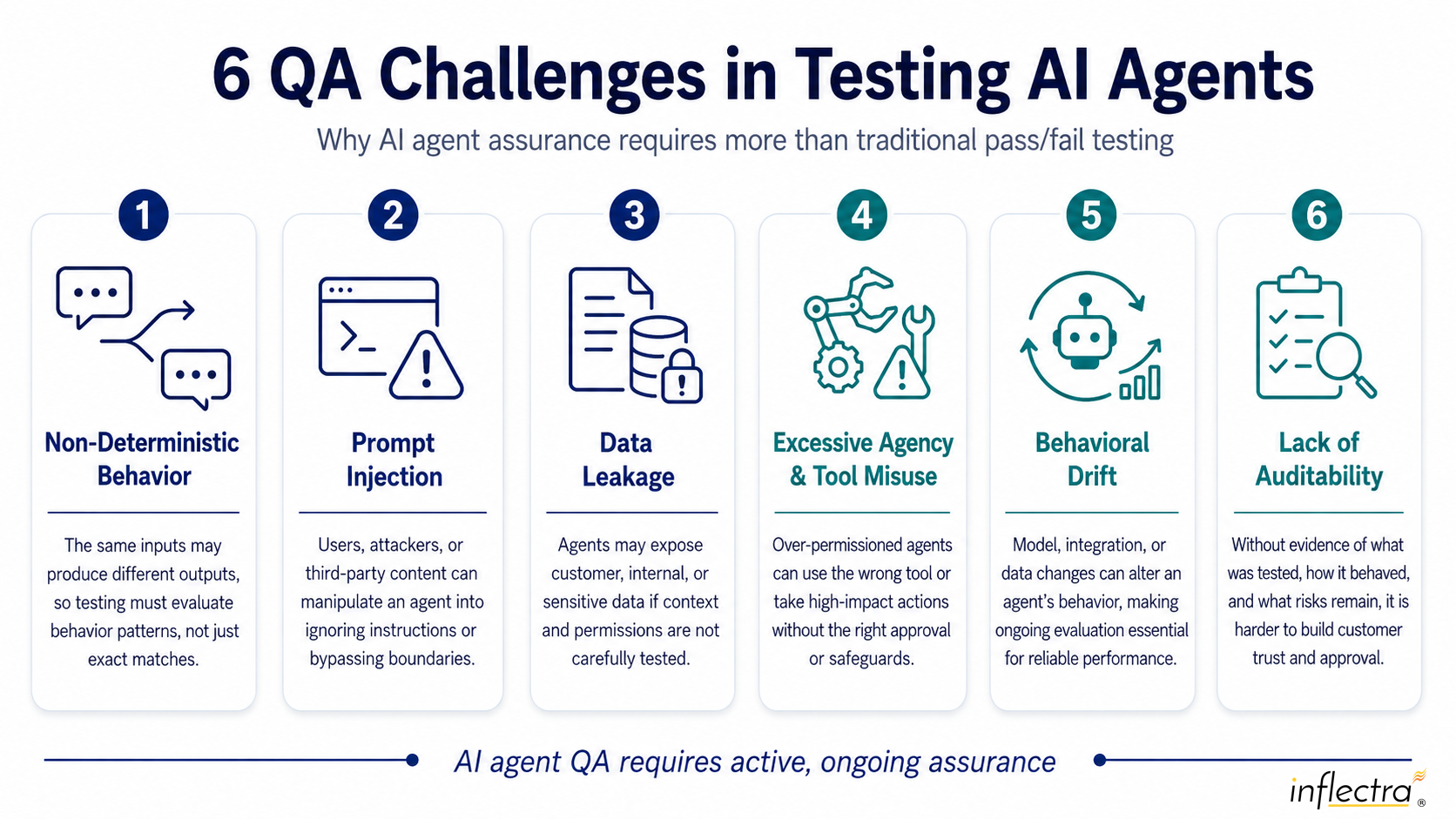
- Non-Deterministic Behavior: Unlike Robotic Process Automation (RPA), AI may respond differently to the same or similar inputs. Agents reason probabilistically, not through fixed logic, which makes traditional pass/fail testing too limited for satisfactory coverage of behavior evaluations.
- Prompt Injection: Users, attackers, or even 3rd-party content can attempt to manipulate AI agents into ignoring instructions, bypassing boundaries, or pursuing the wrong goal. QA teams need to identify these potential vulnerabilities and weaknesses before end users encounter them.
- Data Leakage: As agents gain more autonomy, they are likely to interact with customer data, internal systems, and connected tools. If boundaries are not carefully set and tested, an agent may reveal information that it’s not supposed to share, or use sensitive context in the wrong place.
- Excessive Agency & Tool Misuse: Similarly, the more access that agents have, the more damage they can potentially cause. Using the wrong tool, acting with excessive permission, or performing high-impact actions without proper approval can all be major risks for agents that haven’t been properly tested.
- Behavioral Drift: As models are updated, integrations shift, or new data sources become available, an agent’s behavior may change. In other words, an agent that worked during initial testing may become less reliable over time, which is why we recommend ongoing and persistent evaluations with repeatable metrics.
- Lack of Auditability: Buyers, especially those at enterprise organizations, need more confidence than “the agent looks like it works.” Without evidence of what was tested, when it was tested, how the agent behaved, and what risks remain, it can be difficult to get full buy-in from customers.
SureWire Ensures Safe Development & Deployment to Maximize Value of Agentic AI
Agentic AI gives software vendors a powerful new way to make their products more valuable, adaptive, and outcome-driven. We’ve discussed how it can reduce user effort, complete workflows fast, scale expertise across users, and create competitive advantages through differentiated product experiences.
However, that value depends on trust. Traditional QA tools and frameworks were not built for systems that improvise, vary responses, and operate across such complex workflows, so software teams increasingly need more rigorous ways to test behavior. SureWire is designed to fill this gap, specifically created to evaluate AI agents to the level that they need to be. From dynamic probing and our own bespoke testing agents to repeatable metrics and actionable reports that track agent behavior and reliability over time, SureWire helps teams understand the quality, risks, weaknesses, and ways to improve their agentic systems. It provides software vendors with a more defensible understanding of how your agents behave, where they fail, and what needs to be bolstered before deployment.
Learn more about SureWire here, and sign up to try it today!