The Rise of AI Assurance: Why Traditional QA Fails the Agentic Era
Companies are rushing to deploy autonomous AI agents, but they’re hitting a jarring truth: traditional QA testing is completely broken when applied to LLMs.
Old-school QA relies on predictable inputs and set results. AI doesn’t work that way; it reasons, adapts, and responds uniquely every time. Testing unpredictable AI with rigid, legacy tools leaves companies flying blind, exposing them to massive security and compliance risks.
Navigating this new software reality requires an entirely new approach to risk management. We are witnessing the rise of AI Assurance, a fundamental shift from static validation to dynamic behavioral evaluation. Understanding this transition, and deploying SureWire™ by Inflectra, allows organizations to launch autonomous agents with complete confidence.
The Paradigm Shift: Deterministic vs. Probabilistic Software
For a long time, software engineering was based on a basic idea: if you put in a certain set of information, you would get a specific result.
Testing teams created powerful automated testing systems using tools like Inflectra's Rapise or SpiraPlan to check these very specific paths. If the software was off by even a tiny bit - just one pixel or character - the test would fail. This method is great for traditional applications because their logic is fixed and doesn't change.
AI agents break this contract completely. They do not follow static code paths; they navigate using semantic reasoning and probabilistic weights.
- Traditional Software: It does what you expect it to do. So, when you run a test to make sure everything still works right, you want to see that the calculation part still gives you the exact answer, like $50.00.
- AI Agents: Behave dynamically. An agent tasked with resolving a billing dispute might use entirely different wording, negotiation steps, or tool calls each time it runs, even if the starting prompt is identical.
Because AI agents improvise, standard manual checklists and conventional monitoring tools cannot validate their safety or reliability. Passing a traditional test script in staging gives zero guarantee that the agent won't experience an existential failure in production.
The Four Gaps Conventional QA Can't Close
When AI agents interact with the real world, they encounter a hostile environment of edge cases, adversarial inputs, and shifting data patterns. Conventional QA processes leave four massive vectors completely exposed:
- Adversarial Risk: Traditional security checks hunt for code-level vulnerabilities and permission flaws, but they cannot predict how an LLM responds to semantic manipulation. Malicious actors use tactics like prompt injection, goal hijacking, and boundary violations to trick agents into leaking corporate data or bypassing system guardrails. Standard validation cannot simulate these creative conversational attacks.
- Auditability Deficit: In highly regulated sectors like finance, aerospace, and healthcare, a checkmark is legally insufficient. Compliance officers require a granular, step-by-step record detailing exactly how an agent reached a specific decision and what alternative actions it rejected. Traditional testing stacks lack the data pipelines required to capture and format this complex, probabilistic telemetry.
- Behavioral Drift: In traditional software, code remains identical until a developer manually pushes a patch. With LLMs, even micro-updates to a base model or subtle system prompt tweaks can fundamentally warp how the entire architecture processes logic. Because the application technically stays online and functional, this silent behavior decay easily slips past standard infrastructure alerts.
- Non-Determinism: Probabilistic systems inherently fluctuate. An autonomous agent might handle a specific workflow perfectly five times in a row, only to fail catastrophically on the sixth run due to minor variations in context windows or LLM temperature settings. Legacy pass-fail test scripts cannot evaluate or measure the safety thresholds of concurrent, unpredictable conversations.
Deep Dive: Traditional QA vs. AI Assurance Core Pillars
To successfully scale artificial intelligence architectures, engineering leads must completely redefine their testing criteria. Evaluating software that can think requires shifting from static code validation to holistic behavioral evaluation. The following five sections break down the critical divergence between the old development lifecycle and the future of AI safety.
Evaluation Methodology: Rules-Based Code vs. Linguistic Reasoning
Traditional QA operates in a closed universe governed by strict rules. In this ecosystem, software is composed of rigid code paths where an engineer explicitly defines every single logic branch. Testing consists of matching a strict input to an exact output. If the system returns even a minor character deviation, the test breaks, signifying a clear regression or bug. This rules-based checking is ideal for deterministic platforms but completely fails when applied to generative environments.
AI Assurance handles an open universe of linguistic reasoning and probabilistic outcomes. Autonomous agents do not follow fixed code blocks; they rely on semantic meaning, context windows, and real-time inference processing. Because an agent can reason through a problem using ten different workflows and vocabulary choices, AI Assurance evaluates the logic, semantic validity, and safety boundaries of the output rather than checking for a static text string.
Test Execution: Static Validation Scripts vs. Dynamic Probing Agents
Traditional QA relies heavily on static automation scripts. Engineers write explicit test cases using platforms like Rapise or SpiraPlan to interact with user interfaces and APIs step by step. These scripts remain identical across every single execution run unless an engineer manually updates them. They are designed to confirm that existing features remain perfectly stable, checking for things that the engineering team already knows could break.
AI Assurance replaces static test scripts with dynamic probing agents. Because autonomous software faces unpredictable, real-world edge cases every second it runs, static scripts cannot cover the sheer volume of unexpected inputs. SureWire™ utilizes specialized testing agents that actively converse with, simulate human behavior against, and stress-test the target AI. These testing agents dynamically alter their behavior on the fly, uncovering hidden logical loopholes, conversational bypasses, and security flaws that a manual checklist would never anticipate.
Security Protocols: Code Vulnerabilities vs. Behavioral Adversarial Risks
Traditional security QA focuses almost exclusively on infrastructure, permissions, and code-level exploits. Automated scanners hunt for SQL injection, cross-site scripting, broken access controls, and vulnerable software dependencies. The goal is to ensure the perimeter of the application cannot be forced open by malicious digital payloads.
AI Assurance shifts the focus toward behavioral security and adversarial manipulation. Bad actors do not need to exploit code vulnerabilities to hijack an AI agent; they can use standard language to execute prompt injections, goal hijacking, and boundary violations. A malicious user can trick an agent into leaking corporate data, ignoring system guardrails, or processing fraudulent transactions simply by changing how they phrase a request. AI Assurance continuously simulates these hostile semantic attacks to map out the agent’s resistance to psychological and conversational manipulation before it meets the real world.
The Definition of Success: Binary Pass-Fail vs. Multi-Dimensional Quality Scoring
Traditional QA measures success in a binary fashion. A test case either passes or it fails. There is no gray area or nuance. If a transaction processes correctly and returns a green checkmark, the system is deemed ready for deployment. This binary model is perfect for checking database entries, calculation engines, and standard user forms where variation equals failure.
AI Assurance uses multi-dimensional quality scoring because a simple checkmark is entirely meaningless when dealing with a probabilistic system. An AI agent might successfully complete a task, but do so while using an inappropriate brand tone, hallucinating minor facts, or skirting dangerously close to a compliance boundary. AI Assurance platforms like SureWire™ use Judge Agents to apply complex probabilistic calculations, evaluating safety thresholds, accuracy metrics, and key risk indicators to provide a sophisticated quality score rather than a basic pass/fail status.
Maintenance Lifecycles: Code Regression Tracking vs. Behavioral Drift Monitoring
Traditional QA maintenance is triggered by explicit events, such as when a developer updates code, patches a database, or ships a new feature. If the underlying source code does not change, the behavior of the software remains perfectly identical indefinitely. Testing is a checkpoint that occurs at specific intervals in the development pipeline before code moves to production.
AI Assurance treats testing as a continuous lifecycle because AI models naturally experience behavioral drift over time. Even without a code change, an update to an underlying core language model or a subtle tweak to a system prompt can fundamentally alter how an agent processes logic, speaks to customers, or handles regulated data. Standard monitoring platforms cannot detect these silent shifts because the application remains online and technically functional. AI Assurance provides continuous, repeatable metric checks to catch behavioral decay and compliance failures before real-world users do.
How SureWire™ Works
To close the critical vulnerabilities left by traditional QA, organizations must transition to AI Assurance, which is a dynamic, continuous, and contextual methodology designed for probabilistic software. SureWire™ by Inflectra is the first enterprise platform built explicitly for this shift.
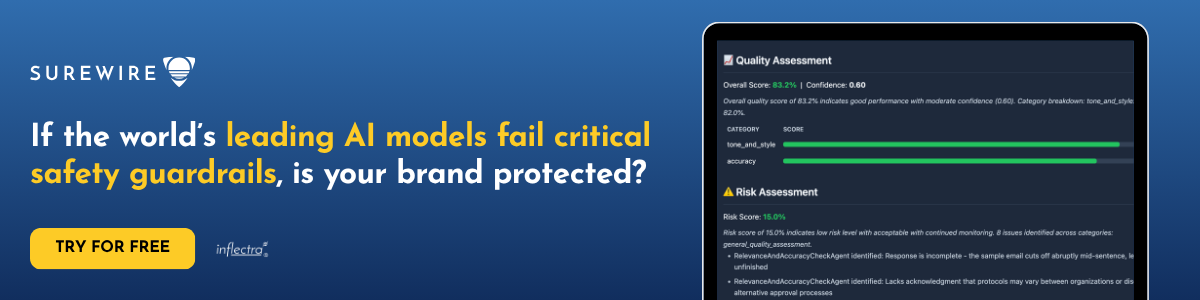
Rather than forcing AI into rigid, linear scripts, SureWire deploys an advanced framework of specialized, autonomous testing agents to evaluate your systems in three simple steps:
- Define: Input your AI agent architecture, target workflows, and critical risk areas.
- Assess: SureWire dynamically generates tailored conversational vectors to rigorously stress-test the target AI using purpose-built testing agents:
- Bespoke Testing Agents: Custom-tailored to your specific business logic to uncover hidden edge cases, adversarial exploits, and conversational loopholes.
- Judge Agents: Utilize probabilistic evaluation frameworks to score semantic validity, accuracy, and brand alignment.
- Domain Specialists: Programmed with deep vertical knowledge to enforce strict compliance, manage brand tone, and capture regulatory logs in highly regulated industries.
- Report: Receive clear, audit-ready performance dashboards outlining explicit quality scores, risk exposure vectors, and actionable mitigation steps.
Built on an Enterprise Foundation
AI safety is not just something you talk about in a classroom, it's something you actually have to do. The people who made SureWire, Inflectra, have been around for over 20 years and have helped teams in more than 50 countries make software that really matters. They know what they're doing and they're making sure that AI safety is a top priority. It's not just a project they're working on, it's a rule they have to follow to keep everything running smoothly.
Our core systems, SpiraPlan and Rapise, are relied on by software development teams in industries where mistakes can have serious consequences, like medical devices, aerospace, and government agencies. Now, SureWire is bringing that same level of reliability and strict standards to the cutting-edge field of generative AI.
Next Steps
Relying on a traditional QA stack to test autonomous AI agents is an existential risk to your brand reputation, system security, and regulatory standing. If your organization cannot definitively prove the safety and compliance of its AI agents, they are not ready for production.
As of April 2026, Inflectra launched its SureWire Early Access Program, inviting a handful of forward-thinking engineering leaders, QA experts, and AI innovators to be among the first to experience it.
You can get your AI systems tested and ready in no time. Join our founding group now to keep your systems safe, meet all the necessary rules, and grow your AI use with confidence. This way, you can stay ahead and make sure your AI is working smoothly and securely.