Overview
Aerospace and defense programs producing deliverable software must demonstrate disciplined planning, traceability, configuration control, verification evidence, and durable records suitable for customer and prime audits. AS9115A is intended as a software-focused supplement to the 9100 quality management system, adding software-specific clarification for processes used to design, develop, and deploy deliverable software.
This paper explains why SpiraTeam is a strong fit for AS9115A-aligned execution and provides a concrete configuration blueprint—workflows, roles, baselines, signatures, traceability, and reporting—that can be adopted as a repeatable operating model.
1. Context: What AS9115A is asking you to prove
AS9115/9115A is positioned as a supplement to 9100 that adds specificity for deliverable software. “Deliverable software” is typically defined as software that is developed or modified for airborne/spaceborne/ground/shipborne contexts, delivered either as a standalone line item or embedded in a product; unmodified COTS components are excluded.
Practically, AS9115A-aligned programs must be able to demonstrate (with objective evidence) that they have:
- Planning artifacts (e.g., Software Development Plan and supporting plans) and governance records.
- Requirements definition and change control, including impact analysis.
- Verification planning and results, with bidirectional traceability.
- Configuration management, including baselines, version control, status accounting, and audits.
- Problem reporting/corrective action, including closure evidence and record retention.
This expectation is visible in prime/supplier flowdowns: for example, Collins Aerospace supplier requirements enumerate SDP contents and call out problem reporting, risk management, tool control, metrics, security/safety requirements, and configuration management planning elements.
cybersecurity themes (e.g., protected environments, tools/utilities, code analysis capability).
2. Why SpiraTeam is a strong fit for AS9115A execution
SpiraTeam is an integrated software lifecycle management platform that manages requirements, tests, plans/tasks, and issues/defects in one environment with end-to-end traceability. For AS9115A, that integrated data model matters because audits typically fail at the seams—where requirements live in one place, test evidence in another, and configuration status somewhere else.
2.1 Key capabilities that map cleanly to AS9115A needs
A. Traceability you can audit
SpiraTeam supports requirements-to-test coverage mapping and traceability reporting (impact analysis, coverage gaps, and “what failed and what it affects”).
B. Baselining for configuration control
SpiraTeam includes baseline management to snapshot requirements, test cases, incidents, and other artifacts at a point in time—supporting robust configuration management and audits.
C. Workflow governance + electronic approvals
Inflectra’s platform supports configurable workflows and electronic signatures integrated into transitions (commonly used for regulated environments). This allows you to enforce gated approvals (e.g., requirement approval, test completion, release authorization) with attributable accountability.
D. Evidence packaging for customer/prime audits
Because requirements, tests, defects, approvals, and baselines live in one system, generating an “audit packet” is primarily a reporting/configuration task—not a multi-tool reconciliation effort.
3. AS9115A-to-SpiraTeam crosswalk (implementation-focused)
Note: This crosswalk is written as an operational mapping (what you need to demonstrate) rather than reproducing AS9115A clause text.
|
What AS9115A programs must demonstrate |
SpiraTeam mechanism |
Configuration you should implement |
|
Controlled planning (SDP + supporting plans; roles; milestones; reviews; records) |
Releases, Documents, Tasks, Milestones, baselines |
“Plans & Reviews” artifact set; review workflow; baseline at major gates |
|
Requirements definition + change control + impact analysis |
Requirements module + traceability links + baselines |
Requirement types, mandatory fields, approval workflow, baseline strategy |
|
Verification planning & results (unit/module/CSCI/CSU testing; environment control; results retention) |
Test cases, test runs, releases, incident linkage |
Test plan structure per release; required environment fields; results retention rules |
|
Problem reporting, tracking, and corrective action |
Incidents/defects with workflow + root cause fields |
PR/FRB workflow with required RCA + verification + closure approval |
|
Configuration management planning (identification, control, status accounting, audits, access control) |
Baselining, permissions, reporting, release management |
Baseline gates; CM roles; status accounting dashboards; periodic baseline diffs |
|
Cyber-aware controlled tools & environments |
Roles/permissions, auditability, controlled workflow, deployment options |
Least-privilege roles; restricted admin actions; controlled integrations & service accounts |

4. Reference configuration: “AS9115A-ready” SpiraTeam operating model
4.1 Project template and information architecture
Create a Project Template that every deliverable-software program inherits:
A. Requirement taxonomy (systems engineering-friendly)
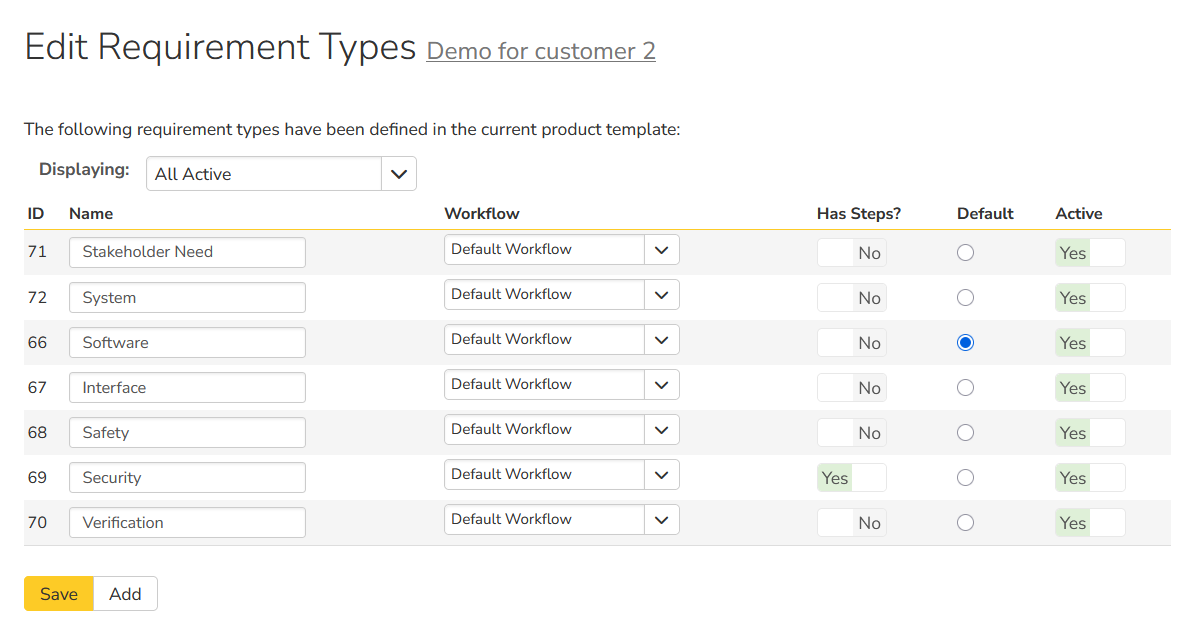
- Requirement Types:
- Stakeholder / Mission Needs
- System Requirements
- Software Requirements
- Interface Requirements (ICD items)
- Safety / Security Requirements
- Verification Requirements (optional, if you separate “what” from “how to verify”)
- Requirement hierarchy:
- Use parent/child decomposition to represent allocation (System → Software → Subsystem → Component).
B. Release structure (align to program increments & baselines)
- Releases = contractual deliveries or major increments.
- Iterations/Sprints (if using Agile) under Releases, but keep baseline gates at the Release level.
C. Standard artifact sets
- Requirements
- Test Cases + Test Sets aligned to verification plan
- Incidents (defects, anomalies, change requests)
- Tasks (implementation + reviews)
- Documents (SDP, SQAP, SCMP, SVP, STR, SVD, etc.)
Supplier flowdowns commonly expect SDP + SCMP + verification/test plan content and explicit records lists.
4.2 Roles, permissions, and segregation of duties
Implement least-privilege roles (examples):
- Systems Engineer (SE): create/edit requirements, propose changes, run traceability reports.
- Software Lead (SWL): manage tasks/releases, approve implementation readiness.
- SQA: independent review authority; can sign/approve transitions; cannot edit code tasks post-baseline without formal CR.
- CM (Configuration Manager): baseline creation authority; release authorization workflow control.
- Test/Verification Lead: manage test sets/runs and verification evidence.
- External Reviewer (Customer/Prime): read-only access to agreed artifacts + reports.
This supports AS9115A’s emphasis on defined responsibilities, independence of QA, and controlled access to records.
4.3 Workflows: gated control with attributable approvals
A. Requirements workflow (example)
- Draft
- Under Review
- Approved
- Implemented
- Verified
- Baselined
- Released
- Obsolete
Recommended gate controls:
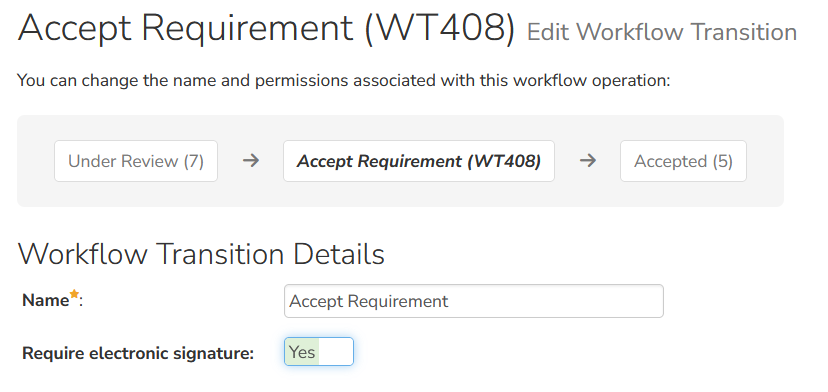
- Under Review → Approved: requires SQA + SE approval (signature if enabled).
- Verified → Baselined: requires CM approval.
- Baselined → Released: requires program authorization.
Spira supports workflow-driven approvals and electronic signature approaches for regulated governance.
B. Incident / problem report workflow (PR/DR)
- New
- Triaged
- Dispositioned (use categories: defect, change request, inquiry)
- In Work
- Fixed
- Verified
- Closed
Mandatory fields by transition:
- Triaged: severity/priority, affected baseline/release, reproducibility, safety/security impact.
- Dispositioned: decision authority + rationale.
- Fixed: root cause category + link to change set/task + regression scope.
- Closed: verification evidence + SQA closure approval.
This directly addresses “problem reporting, tracking and corrective action system” expectations seen in aerospace flowdowns.
C. Test workflow (test case and test run governance)
- Test Case: Draft → Reviewed → Approved → Active → Retired
- Test Run: Planned → Executed → Reviewed → Accepted (signature at acceptance gate if your process requires it)
4.4 Data model: mandatory fields that make audits painless
Configure custom properties to ensure every artifact carries audit-relevant metadata without manual narrative reconstruction.
Requirements (minimum recommended fields)
- Unique ID (native)
- Source (contract, ICD, hazard analysis, stakeholder)
- Criticality (safety/security/mission)
- Verification Method (Test / Analysis / Inspection / Demonstration)
- Verification Level (unit / subsystem / system)
- Acceptance Criteria
- Owner + Approver(s)
- Allocated Component / Subsystem
- Link to hazards/threats (if applicable)
Test Cases / Runs
- Verification method + level
- Environment configuration ID (test bench, simulator version, dataset)
- Pass/fail criteria
- Evidence attachment/link + baseline tag
Incidents
- Affected baseline(s)
- Root cause category (requirements, design, code, integration, environment)
- Corrective action summary + preventive action (if applicable)
4.5 Configuration management with baselines (core to AS9115A)
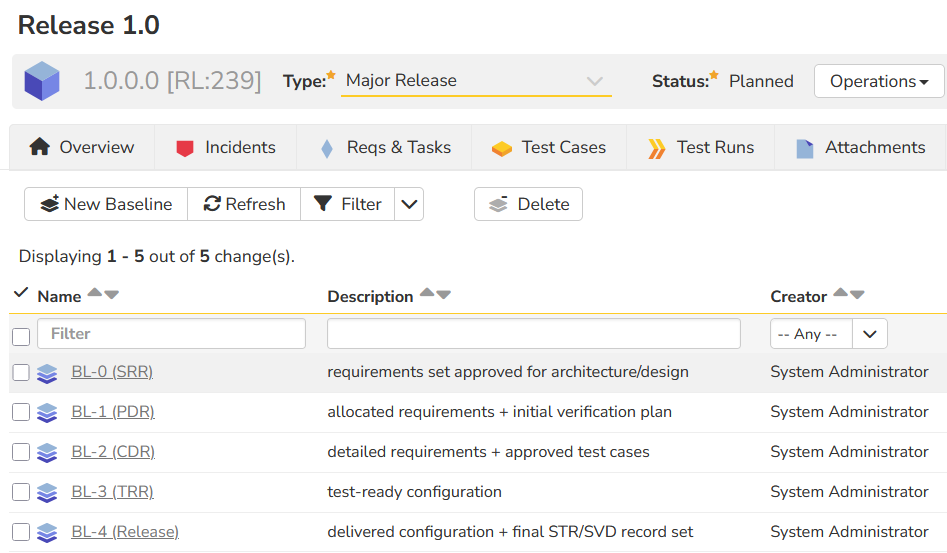
Baselines are your “configuration snapshots” for audits, release readiness, and change impact. SpiraTeam baselining is explicitly designed to support robust configuration management over requirements, test cases, and other artifacts.
Recommended baseline strategy
- BL-0 (SRR): requirements set approved for architecture/design
- BL-1 (PDR): allocated requirements + initial verification plan
- BL-2 (CDR): detailed requirements + approved test cases
- BL-3 (TRR): test-ready configuration
- BL-4 (Release): delivered configuration + final STR/SVD record set
Baseline rules
- Only CM can create baselines.
- After baseline creation, changes require a formal change request incident and new baseline increment.
- Use baseline diff reporting as configuration status accounting evidence.
4.6 Planning artifacts and record retention (SDP/SQAP/SCMP/SVP)
Instead of treating plans as disconnected Word/PDF files, manage them as controlled records with:
- Document versioning and controlled approval workflow
- Links from plan sections to the governing artifacts (requirements sets, test sets, baseline IDs)
- Baseline association at major gates
This aligns to typical SDP expectations such as formal reviews, metrics, risk management, tool control, subcontractor management, and security/safety requirements.
Operational tip: create a “Plan Compliance Matrix” artifact (document or report) that links:
- SDP section → Spira artifact(s) → evidence report(s) → baseline(s)
4.7 Tool/environment control and cybersecurity themes
AS9115A revision materials highlight the need to consider threat profiles and protect software environments (tools/utilities, cyber-protected environments, analysis capabilities).
- Dedicated admin roles (few users) and change-controlled configuration updates
- Service accounts for integrations (CI, source control) with scoped permissions
- Periodic access reviews (export user/role listings for audit evidence)
- Environment identifiers recorded on test runs and baselines
- Secure deployment posture (on-prem/controlled hosting as required by program constraints)
5. Implementation plan (what you do in the first 30–60 days)
Phase 1 — Process definition (Week 1–2)
Deliverables:
- Lifecycle SOPs (requirements, V&V, CM, PR/DR handling)
- Baseline strategy + review gates
- Audit packet definition (what gets produced at each gate)
Phase 2 — SpiraTeam configuration (Week 2–4)
- Build the project template (types, fields, workflows)
- Configure roles/permissions and segregation of duties
- Configure baselines and release structure
- Configure signature/approval gates consistent with your governance approach
Phase 3 — Reporting and audit packet automation (Week 4–6)
Create standard reports:
- Requirements Traceability Matrix (Req ↔ Test ↔ Incident)
- Baseline content report (what’s in BL-x)
- Open anomalies by baseline/release
- Verification status by requirement criticality
- Change impact summary (baseline diffs + linked CRs)
SpiraTeam’s native traceability and baselining are the keystone here.
Phase 4 — Pilot and institutionalize (Week 6–8)
- Run one increment end-to-end in SpiraTeam
- Conduct a mock audit using your defined audit packet
- Adjust fields/workflows to eliminate “offline evidence”
6. What auditors and primes will like about this approach
- Objective evidence is inherent: traceability, baselines, approvals, and defect closure live together.
- Change impact is fast and defensible: you can show exactly what changed between baselines and why.
- Verification evidence is organized around requirements, which is where audits usually start.
- Governance is enforceable: workflows and (optionally) signatures prevent “informal approvals.”
7. How Does It Relate to DO-178C?
In summary, AS9115A governs how aerospace organizations manage software quality, while DO-178C governs whether a specific airborne software product is safe enough to fly.
- AS9115A creates a repeatable, controlled environment
- DO-178C consumes that environment to produce certifiable evidence for a specific product that was developed in that environment
You can think of AS9115A as ensuring “does this organization consistently manage software delivery in a controlled, auditable, and compliant way?” whereas DO-178C asks specifically “is this specific software safe enough to fly?”.
8. Appendix: Example “AS9115A-ready” checklists
A. Minimum required fields checklist
- Requirements: source, criticality, verification method, acceptance criteria, approver, baseline tag
- Tests: environment ID, evidence, linked requirements, approval
- Incidents: affected baseline, root cause, corrective action, verification, closure approval
B. Baseline readiness checklist
- 100% requirements in scope are Approved
- Planned verification coverage defined for all requirements
- No open “must-fix” anomalies for the target baseline
- All required plan documents approved and linked to baseline
- Baseline diff report generated and stored as record
C. Audit packet contents (per release)
- RTM (Req↔Test↔Defect)
- Baseline definition + diff from prior baseline
- Verification summary + failed test disposition
- Open/closed PR log with RCA & closure evidence
- Approved SDP/SQAP/SCMP/SVP and review minutes (or equivalent records)