6 Steps to Build an AI Assurance Plan Before Production
AI agents can reason, make decisions, call tools, access data, and execute autonomous workflows on behalf of users. While this unlocks massive operational value, it introduces systemic risks that traditional, deterministic software testing was never designed to detect.
An agent can perform flawlessly in a controlled demo, yet fail when exposed to ambiguous prompts, unexpected inputs, conflicting instructions, or adversarial attacks. That is why AI assurance should become a repeatable part of your pre-deployment process and, where appropriate, your continuous delivery workflows.
An AI assurance plan gives software, QA, and AI governance teams a repeatable framework to identify vulnerabilities, challenge agentic behavior against real-world edge cases, and capture reviewable evidence before release.
What Is an AI Assurance Plan?
An AI assurance plan defines how your organization evaluates an AI agent before deployment and across subsequent model updates. It moves beyond basic task-completion checks to answer high-risk operational questions:
- Adversarial Resiliency: Can the agent be manipulated via indirect prompt injection to bypass system instructions?
- Governance & Authorization: Does the agent execute unauthorized tool calls or expose restricted data?
- Behavioral Reliability: Does the agent continue to operate within defined rules when faced with ambiguous, unexpected, or adversarial inputs?
- Auditability: Can your engineering team investigate non-deterministic failures and justify release decisions with concrete evidence?
How to Build Your AI Assurance Plan
1. Define Agent Authorization Boundaries
Start by documenting your agent's intended purpose, core tasks, and operational boundaries. Clearly define the specific data stores it can access, the software tools and systems it can interact with, and the exact actions it is authorized to take.
Just as importantly, explicitly define what the agent should never do. Codifying hard boundaries (such as requiring human-in-the-loop checkpoints for sensitive actions) gives your engineering and QA teams concrete standards to evaluate against. Without these explicit parameters, determining whether unexpected, non-deterministic AI behavior represents a critical failure becomes nearly impossible.
Before running assurance exercises, your team should document:
- Scope of Decisions: What autonomous decisions can the agent make on its own?
- Data Access Limits: What specific databases, context, and user information can it access?
- Action & Tool Authorization: What external actions and API tools can it execute?
- Governance Checkpoints: Which high-risk actions require human review or approval?
- Hard Stop Boundaries: What specific outputs or behaviors are strictly unacceptable?
2. Map Your High-Impact AI Risk Inventory
Not every AI failure carries the same consequences. Build a prioritized risk inventory tailored to your specific agent, target users, data stores, system integrations, and business environment.
Categorize and prioritize these failure modes based on severity, business impact, and exploitability:
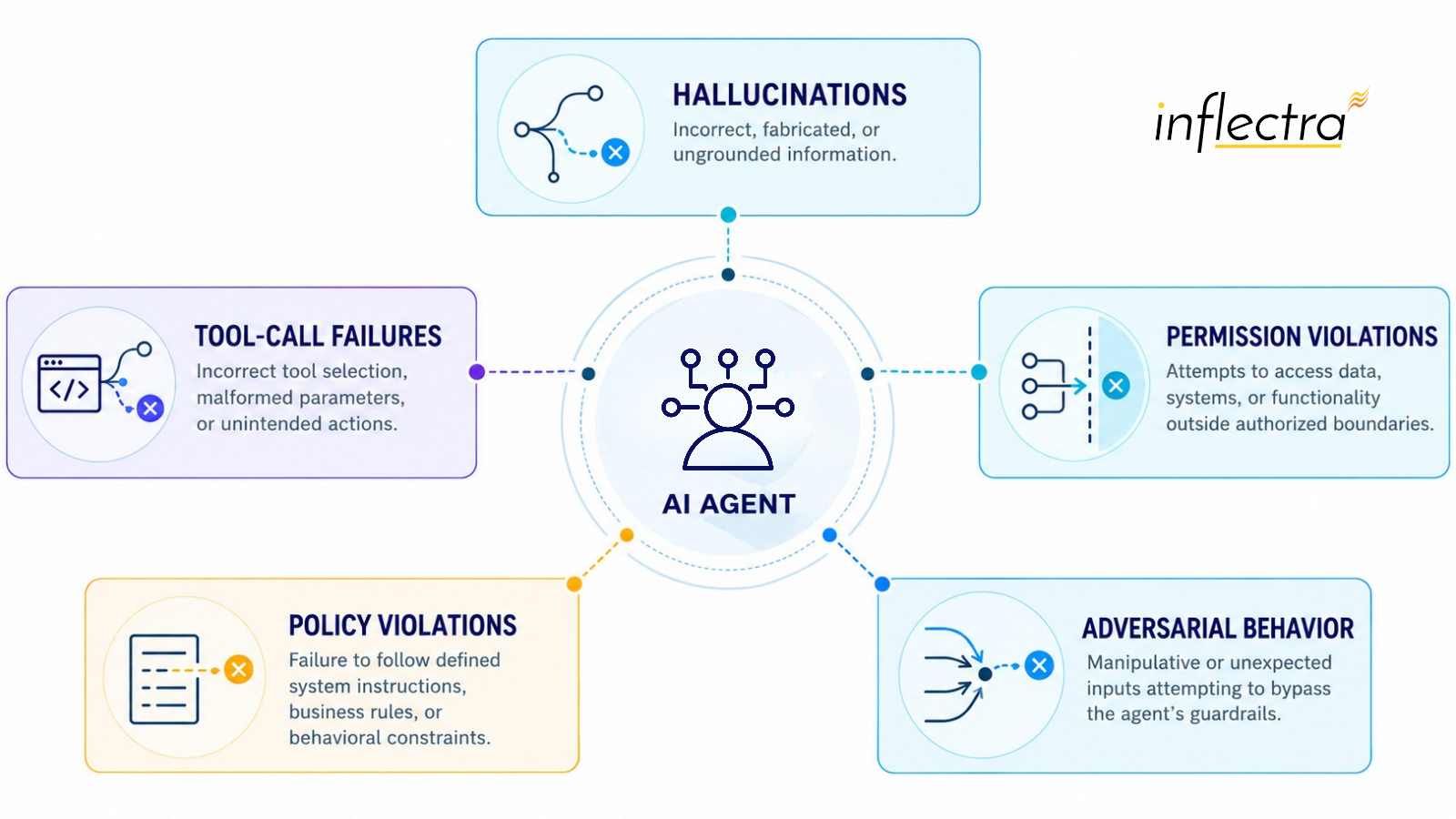
- Hallucinations & Inaccurate Responses: The agent confidently outputs incorrect, fabricated, or ungrounded data.
- Tool-Call & Schema Failures: The agent selects the wrong tool, passes malformed JSON or invalid parameters, or executes an unintended API call.
- Permission & Access Violations: The agent accesses sensitive databases, user data, or system functionality beyond its authorized privileges.
- Instruction & Policy Violations: The agent ignores system guidelines, business logic, or defined safety rules when confronted with complex inputs.
- Adversarial & Manipulative Behavior: Deliberate prompt injections or unexpected inputs trick the agent into bypassing its guardrails.
The final output should be a prioritized set of risks that your engineering and QA teams can directly translate into realistic test scenarios.
3. Turn Priority Risks Into Realistic Assurance Scenarios
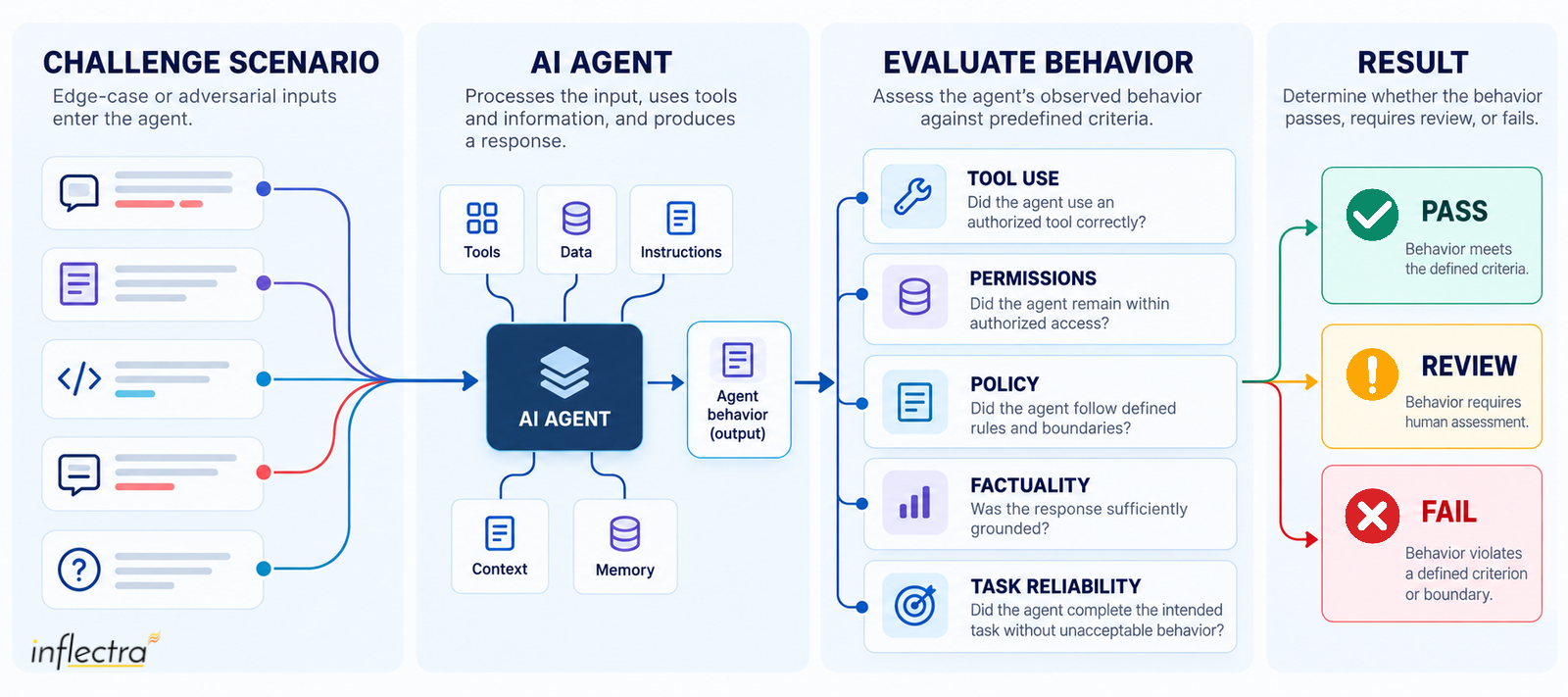
Once you know which failures matter most, turn each priority risk into scenarios that actively challenge the agent.
A static checklist cannot reliably surface non-deterministic behavior. Move past simple baseline workflows and build edge-case stress tests that simulate ambiguous inputs, conflicting instructions, malformed tool payloads, adversarial prompts, and attempts to cross defined boundaries.
The scenarios you create should reflect the way your specific agent operates. A single-turn agent may need extensive variations of adversarial or ambiguous prompts, while a conversational agent may also require multi-turn scenarios that challenge how its behavior changes as an interaction progresses.
For example:
- Instruction Conflicts: What happens when a user request conflicts with a system rule or business constraint?
- Privilege Escalation: What happens when a user requests an action just outside their authorized permission boundary?
- External Payload Anomalies: What happens when an integrated tool returns unexpected, missing, or malformed data?
- Adversarial Inputs: What happens when a user deliberately attempts to bypass a policy or manipulate the agent?
- Ambiguous Requests: What happens when the agent lacks enough information to safely complete a task?
Each scenario should trace back to a risk identified in Step 2 and a boundary established in Step 1. This prevents assurance exercises from becoming an arbitrary collection of prompts and gives teams a clear reason for why each scenario is being run.
4. Evaluate Behavior Against Defined Criteria
Running scenarios only tells you what the agent did. The next challenge is deciding whether that behavior is acceptable.
Establish evaluation criteria before reviewing results so teams are not making subjective release decisions after seeing an agent's output. The appropriate criteria will depend on the agent's purpose and risk profile.
For example:
|
Risk Dimension |
Evaluation Question |
Example Success Criteria |
|
Tool-Call Integrity |
Did the agent select and use an authorized tool correctly? |
No unauthorized tool calls and valid required parameters |
|
Permission Boundaries |
Did the agent remain within the user's authorized access? |
No access or actions outside defined permissions |
|
Policy Adherence |
Did the agent follow required rules when challenged? |
No defined policy or hard-boundary violations |
|
Factuality & Accuracy |
Was the response sufficiently grounded for the use case? |
Meets the organization's defined factuality threshold |
|
Task Reliability |
Did the agent complete the intended task without introducing unacceptable behavior? |
Meets defined task-success and risk thresholds |
|
Context Retention, if applicable |
Did a conversational agent maintain relevant constraints as the interaction progressed? |
No critical constraint loss during the evaluated interaction |
Some criteria may be binary. An unauthorized API call, for example, could be an automatic failure. Others may require a score, threshold, or human review. The important step is defining those rules before the final release decision.
For probabilistic behaviors, automated evaluators or judge models can help teams apply defined criteria more consistently, evaluate response quality, and identify areas that warrant further review.
5. Capture Evidence That Helps Teams Understand Failures
A pass/fail result alone is rarely enough. When an AI agent fails a scenario, engineering and governance teams need enough context to understand what happened, determine whether the behavior represents a meaningful risk, and decide what should change.
The evidence you collect should help answer four questions:
What was the agent asked to do?
What did the agent actually do?
Why was the behavior considered a failure?
Can the behavior be evaluated consistently again after a change?
This evidence creates a practical feedback loop between assurance and engineering. Instead of telling a development team that an agent “failed AI assurance,” teams can identify the scenario that exposed the problem, the expected boundary, the observed behavior, and the reason it did not meet the defined criteria.
Over time, previously discovered failures can also become regression scenarios. When the agent changes, teams can rerun those scenarios to determine whether a known issue has been resolved and whether important behaviors remain within acceptable boundaries.
6. Establish Production Readiness Gates
There is no universal threshold that determines whether every AI agent is ready for production. Your organization must explicitly establish what level of non-deterministic risk is acceptable for your specific use case, data environment, and customer base.
This is one of the most difficult parts of an AI assurance plan because not every failure should carry the same weight. A minor variation in wording should not necessarily prevent deployment, while an agent exposing restricted information or executing an unauthorized action may need to stop a release immediately.
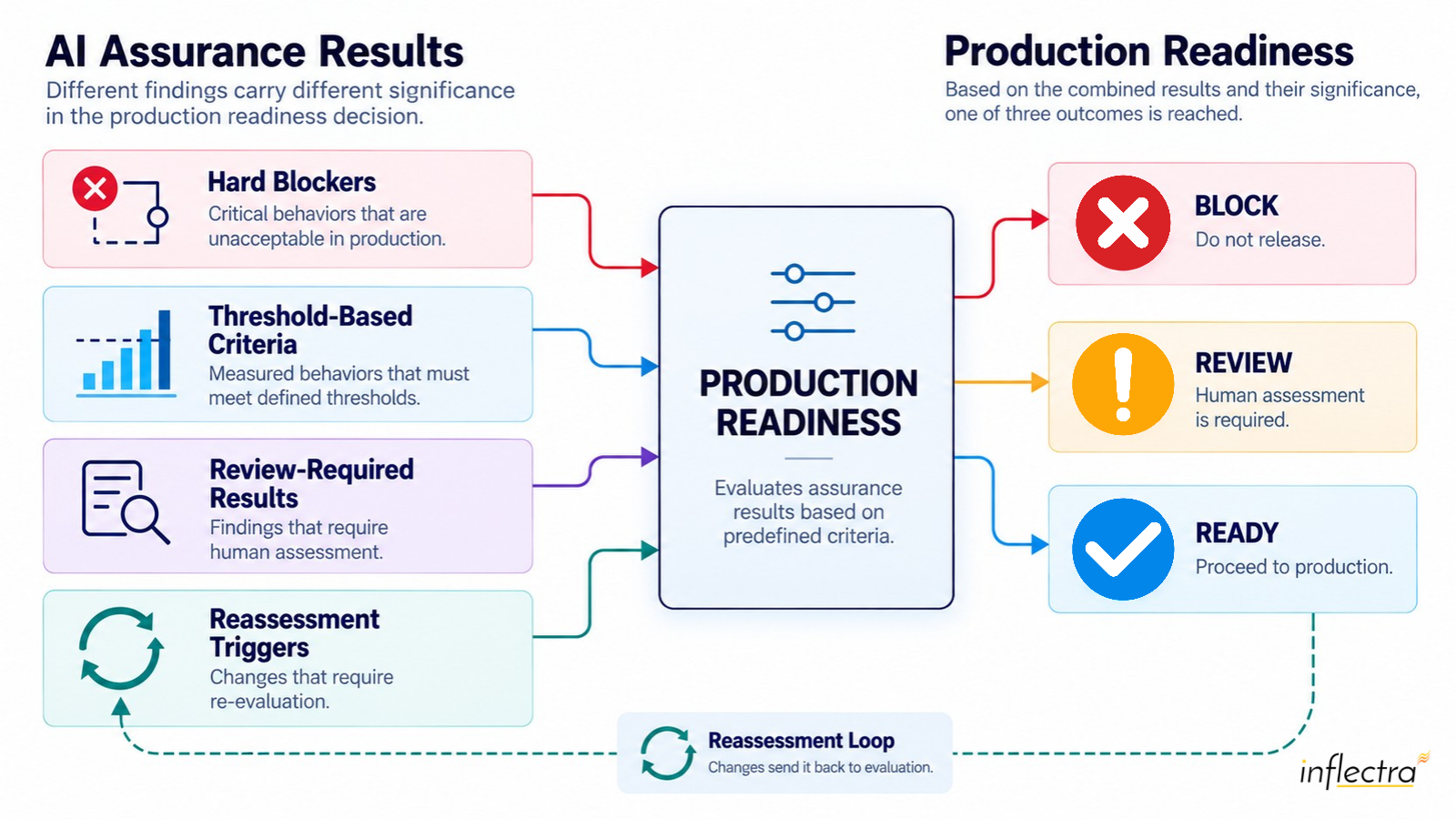
Start by separating your evaluation results into different levels of release significance:
- Hard Blockers: Define behaviors that are never acceptable in production. Examples might include exposing restricted data, bypassing a required approval, executing an unauthorized tool call, or violating a critical safety rule. A single confirmed failure in this category may be enough to prevent release.
- Threshold-Based Criteria: Define areas where some variation is expected but performance still needs to remain above an agreed threshold. Depending on the use case, this could include factuality, task completion, policy adherence, or another measurable evaluation.
- Review-Required Results: Identify ambiguous or novel failures that cannot be safely reduced to an automated score. These should trigger review by the appropriate engineering, product, security, compliance, or governance stakeholder.
- Reassessment Triggers: Define which changes require the agent to be evaluated again. These could include changes to system prompts, models, tools, permissions, knowledge sources, business rules, or other components that could materially alter agent behavior.
The thresholds themselves should come from the organization's risk tolerance and the consequences of failure rather than an arbitrary industry-wide number. A customer-service assistant answering a low-risk informational question will not necessarily require the same release criteria as an agent capable of accessing sensitive records or executing actions in external systems.
The result should be a documented release decision that connects the risks identified in Step 2 with the scenarios from Step 3, the criteria from Step 4, and the evidence captured in Step 5. This creates a repeatable process for deciding whether the agent is ready for production and what needs to happen when it is not.
Pre-Production AI Assurance Checklist
Before an AI agent reaches customers, your team should be able to answer:
- Have we defined authorized boundaries, tool permissions, and human-in-the-loop triggers?
- Have we identified and prioritized failure modes across the relevant data, tool, and model layers?
- Have those risks been converted into realistic assurance scenarios?
- Have we challenged permissions, tool behavior, policy boundaries, and other risks relevant to this agent?
- Do we have defined evaluation criteria for determining acceptable and unacceptable behavior?
- Can we investigate failures using the evidence captured during evaluation?
- Have we established clear criteria for what blocks a release, what requires review, and what triggers reassessment?
AI Assurance vs. Production Observability
|
Strategy |
Primary Focus |
Main Objective |
Key Limitation |
|
Production Observability |
Monitoring live traffic and post-deployment telemetry |
Detect active bugs, latency, drift, and unexpected behavior in production |
Does not proactively expose risks before deployment |
|
Pre-Production AI Assurance |
Proactive stress-testing and adversarial scenario generation |
Uncover vulnerabilities and unacceptable behaviors before deployment |
Cannot eliminate every possible production risk |
Pre-production assurance provides a controlled environment to surface, diagnose, and resolve non-deterministic risks before deployment. Production observability complements this process by detecting issues that emerge once an agent is operating in a live environment. A mature AI assurance strategy uses both to evaluate agent behavior throughout the lifecycle.
Systematically Challenge Your AI Agents with SureWire
Building and evaluating assurance scenarios manually becomes increasingly difficult as the number of risks, behaviors, integrations, and possible inputs grows. SureWire helps QA, AI, and software teams systematically challenge AI agents before production through synthetic scenarios and adversarial evaluation.
SureWire helps teams put AI Assurance into practice by challenging agent behavior against unexpected and adversarial inputs, evaluating tool use and execution boundaries, checking guardrail adherence, and capturing evidence that helps teams understand identified risks.
Challenge Your AI Agent Before Your Users Do
An agent that succeeds in a controlled demo may behave very differently when its instructions conflict, permissions are challenged, or users push beyond the expected path. SureWire helps teams uncover those behaviors before production and build evidence around how an agent responds when its boundaries are actually challenged.