AI Assurance for the Enterprise
The adoption of Generative Artificial Intelligence (AI) and its newer incarnation – Agentic AI - is rapidly moving from experimental pilots into production systems. These Large Language Model (LLM)-based systems make recommendations, summarize regulated information, interact with customers, generate code, automate workflows, and increasingly act autonomously on behalf of users.

This shift creates a fundamentally new assurance challenge. Traditional software quality practices were designed for deterministic systems where the same input usually produces the same output. AI-enabled systems, especially generative AI and agentic AI systems, are probabilistic, context-sensitive, and often connected to external tools, private data, and business-critical workflows.
1. What Is AI Assurance?
AI assurance is the structured process of establishing and maintaining confidence that an AI system behaves as intended, operates within acceptable risk boundaries, complies with relevant policies and regulations, and continues to perform safely over time.
Furthermore, AI assurance is critical in demonstrating that AI systems are safe, accurate, reliable, secure, explainable, compliant, and aligned with organizational intent. It brings together governance, risk management, requirements management, testing, red-team evaluation, monitoring, auditability, and lifecycle traceability into a single methodology.

It is broader than AI testing. Testing is one part of assurance, but assurance also includes governance, documentation, risk management, traceability, approvals, monitoring, and audit evidence.
A mature AI assurance program answers questions such as:
- Can we define what this AI system is supposed to do?
- Can we identify the risks associated with its use?
- Can we translate those risks into controls, requirements, and test cases?
- Can we test the system against realistic and adversarial scenarios?
- Can we detect hallucinations, prompt injections, data leakage, unsafe behavior, and behavioral drift?
- Can we prove that failures were recorded, triaged, remediated, and retested?
- Can we demonstrate this evidence to executives, customers, auditors, regulators, and internal governance teams?
In conventional software delivery, assurance often focuses on whether functionality meets requirements. In AI systems, assurance must also address whether the system behaves acceptably across ambiguous, adversarial, or probabilistic situations.
For example, an AI agent may pass a normal user journey but fail when exposed to malicious instructions embedded in third-party content. A chatbot may answer correctly most of the time but produce a confidently wrong answer in a regulated domain. A code-generation assistant may work well for simple tasks but introduce insecure patterns when handling edge cases. A customer-service agent may resolve routine requests but disclose sensitive information when prompted indirectly.
AI assurance exists because these risks cannot be managed through simple functional testing alone.
2. Why Do We Need AI Assurance Now?
AI Has Moved from Experimentation to Production
Many organizations began using AI through small pilots: internal chatbots, document summarization, code assistance, test-case generation, support-ticket triage, or knowledge-base search. These use cases often started outside traditional governance processes because they were seen as low risk or experimental.
That is changing. AI is now being embedded into customer-facing applications, regulated workflows, product features, business operations, development pipelines, and decision-support systems. Once AI becomes part of production software, it inherits the same expectations as other enterprise systems: reliability, security, accountability, compliance, and auditability.
The challenge is that AI introduces failure modes that traditional enterprise software delivery processes were not designed to manage.

Unauthorized Actions
The agent could send emails, approve refunds, change records, place orders, delete files, or trigger workflows it was never supposed to execute.
A major Canadian airline’s website chatbot told a customer he could buy a full-fare ticket and later apply for a bereavement discount, even though that was not the airline’s actual policy.
Data Leakage
An AI agent may expose confidential information such as customer data, financial records, source code, contracts, or internal strategy to the wrong people or systems. It could leak Personally Identifiable Information (PII) or Protected Health Information (PHI).
In 2024, a hacker used Telegram chatbots to leak policyholder data from India’s largest health insurer, including medical records and personal details.
Compliance & Legal Exposure
A rogue agent can violate regulations, contractual obligations, audit controls, or retention rules, creating liability in industries like finance, healthcare, and government.
In a high-profile legal case in New York in 2023 also involving an airline, lawyers filed a brief containing fake cases generated by ChatGPT. A federal judge sanctioned the lawyers and their firm.
Financial Loss
An AI agent with insufficient guardrails can let unscrupulous or malicious users use it for unintended purposes that are financially ruinous to the organization providing the agent, but financially beneficial to the end user.
A famous example was when a fast food chatbot that was programmed to answer questions on menu items could be tricked into performing coding tasks that required considerable computation power. A well crafted prompt would cause the chatbot to generate complex Python code embedded in a response explaining the virtues of a specific chicken sandwich. As the cost of agentic software development tools increases, the temptation to hijack public AI agents will become increasingly likely.
Operational Disruption
The agent may corrupt data, create conflicting updates, overwhelm systems with automated activity, or break business processes that depend on accuracy and sequencing.
In early 2026, a system failure caused more than 100 robotaxis in China to stop in the road, stranding passengers and disrupting traffic. A similar event with self-driving cars happened in San Francisco a couple of weeks later.
Reputational Damage
If customers see harmful, deceptive, offensive, or simply wrong behavior, trust drops fast. One visible incident can damage brand credibility far beyond the original technical failure.
One of the first chatbots released by a major software company began posting racist and sexist content on X/Twitter and was taken offline within a day. The fact that this event is well known by anyone in the industry almost 10 years later, demonstrates the long-term reputational damage from a rogue AI.
3. How is AI Assurance Different?
AI Assurance is fundamentally different to traditional automated functional testing. Traditional automated testing assumes that a system is mostly deterministic. Given a known input, the system should produce a known output. Test cases can be written as predictable pass/fail assertions.
Generative AI and agentic AI systems behave differently. Their outputs may vary across runs. Their behavior can depend on prompts, retrieved documents, system instructions, tool access, conversation history, model version, temperature settings, external APIs, embedded content, and user intent. This makes simple scripted testing inadequate. In many ways, AI assurance is closer in approach to load/performance testing where you have to run hundreds of thousands of simulations with different inputs to find performance bottlenecks.
In addition to needing a large number of varied inputs, AI systems can fail in ways that are hard to detect with conventional QA:
- They may hallucinate plausible but false information.
- They may reveal sensitive data.
- They may follow malicious instructions hidden inside retrieved content.
- They may make unsafe recommendations.
- They may use tools in unintended ways.
- They may violate policy while appearing helpful.
- They may degrade when the underlying model or retrieval corpus changes.
- They may produce inconsistent results across similar inputs.
Some of these behaviors can be tested for using a known “golden dataset” of correct answers, but for open chat interfaces, it is not usually possible to cover all possible input prompts with golden datasets.
4. Regulation and Governance Expectations Are Rising
In addition to the risks of AI becoming more critical, AI assurance is also becoming a compliance issue. For example, the NIST AI Risk Management Framework establishes a structured approach for managing AI risk across the AI lifecycle, organized around Govern, Map, Measure, and Manage functions. The ISO/IEC 42001 standard also establishes an international management-system certification for establishing, implementing, maintaining, and continually improving an Artificial Intelligence Management System.
Regulation Moving Beyond Frameworks
Going beyond frameworks and standards, the EU AI Act, Regulation 2024/1689, creates a comprehensive legal framework for AI in Europe and introduces obligations for high-risk AI systems, including risk management, technical documentation, recordkeeping, human oversight, accuracy, robustness, and cybersecurity. The EU AI Act is the first comprehensive legal framework for AI and is designed to foster trustworthy AI in Europe. For high-risk AI systems, the Act includes expectations around recordkeeping, human oversight, accuracy, robustness, and cybersecurity. High-risk AI systems may include systems used as safety components or systems listed in high-risk categories, and providers that determine a system is not high-risk may still need to document that assessment.
Similar to how the EU General Data Protection Regulation (GDPR) because the “gold-standard” for data privacy, the EU AI Act could become the template for similar legislation everywhere. As an immediate response to the EU Act, LLM vendors have already introduced “watermarking” technology to encode subtle markers into generated content so that it can be recognized as AI generated.
For organizations deploying AI in regulated or high-consequence environments, the stakes are even higher. There have been many well publicized incidents of AI agents and applications disclosing sensitive information or taking unauthorized actions, with significant financial regulatory and financial consequences for the organization.
AI Failures Are Business Failures
Even when a regulation does not directly apply, these frameworks are shaping buyer expectations. Enterprise customers increasingly want vendors to show how AI features are governed, tested, monitored, and documented.
AI failures are not just technical defects. They can become legal, reputational, financial, operational, and safety issues. An AI system that produces the wrong medical recommendation, mishandles financial information, exposes private data, generates biased decisions, or executes an unauthorized workflow can create material business risk. Even less severe failures can erode user trust quickly.
For software companies, the risk is especially acute. Customers are asking vendors to add AI capabilities, but they are also asking harder questions:
- How do you test your AI features?
- Do you evaluate for hallucinations?
- How do you prevent prompt injection?
- Do you monitor for drift?
- Can you provide audit evidence?
- Can AI-generated outputs be traced back to requirements, risks, and tests?
- Can your AI features be validated in regulated environments?
- AI assurance gives organizations a credible answer.
Agentic AI Raises the Stakes
AI agents are more complex than chatbots. They do not merely answer questions; they may plan tasks, call tools, retrieve data, modify records, interact with APIs, generate artifacts, trigger workflows, or operate semi-autonomously.
That creates a new assurance problem. Organizations need to validate not only the content of an AI response, but also the behavior of the agent across a workflow. This is why AI assurance requires both lifecycle governance and execution-level behavioral validation.
5. What Key Capabilities Should You Look For?
A credible AI assurance platform should include capabilities across governance, risk, testing, evidence, and operations. The strongest solutions will not treat AI assurance as a standalone lab activity. They will connect AI risk management directly into the software delivery lifecycle.
AI Requirements Management
AI assurance starts with defining what the system is expected to do.
Teams should be able to capture functional requirements, non-functional requirements, policy requirements, regulatory requirements, model behavior requirements, guardrail requirements, human oversight requirements, and acceptance criteria.

For example, a set of requirements for an AI system could include:
- The AI assistant shall not expose confidential customer data.
- The AI agent shall request human approval before executing a financial transaction.
- The AI system shall cite approved sources when answering regulated-domain questions.
- The AI feature shall refuse instructions that attempt to override system policy.
- The AI agent shall log tool usage for audit review.
These requirements need to be versioned, reviewed, approved, baselined, and traced to tests and risks.
AI Risk Management
AI systems introduce new categories of risk. A platform should allow teams to identify, score, prioritize, mitigate, and monitor risks such as:
- Hallucination risk
- Prompt-injection risk
- Data-leakage risk
- Bias and fairness risk
- Insecure tool-use risk
- Unauthorized action risk
- Model-drift risk
- Retrieval-quality risk
- Regulatory noncompliance risk
- Explainability and auditability risk
- Human-oversight failure
Each risk should connect to controls, mitigations, requirements, tests, defects, releases, and evidence.
A sample risk register would look like:

Traceability from Governance to Execution
AI assurance requires a chain of evidence. For example, a business policy should trace to an AI requirement. The AI requirement should trace to one or more risks. The risk should trace to mitigation controls and test scenarios. The test scenarios should trace to execution results. Failures should trace to defects or corrective actions. Releases should trace back to the complete evidence package.

This end-to-end traceability is especially important for regulated industries and high-consequence AI systems. This is nothing new; such end-to-end traceability is common in high assurance systems such as aerospace platforms, medical devices and automotive systems. However with AI, this level of traceability need to be in place for all systems that include embedded AI workflows or agents.
AI-Specific Test Execution
AI systems require specialized evaluation methods. As described above, an AI system is probabilistic in nature (vs. deterministic) and therefore, traditional methods for functional testing inherently fall short. For example, with a deterministic system, following the same workflow with the same data will generate identical results each time, with AI, the results will vary. Therefore, the AI testing platform needs to test specifically for:
- Prompt injection
- Jailbreak attempts
- Data leakage
- Toxic or unsafe outputs
- Incorrect or misleading answers
- Policy violations
- Unauthorized tool usage
- Goal deviation
- Behavioral inconsistency
- Regression across prompt, model, or data changes
- Multi-turn conversation failures
- Agent workflow failures
This is where AI assurance diverges from standard test automation. AI behavior cannot always be evaluated with exact string matching or binary pass/fail assertions.

Teams need evaluation mechanisms that can judge semantic correctness, policy alignment, refusal behavior, safety, consistency, and context relevance.
Red Teaming and Adversarial Testing
AI systems need to be tested against hostile, unexpected, and manipulative inputs. Adversarial testing helps identify weaknesses before attackers, users, or downstream systems exploit them. This is particularly important for AI agents that read untrusted content, access private data, or call external tools.
Prompt injection is a major example. An attacker may embed instructions inside a document, support ticket, webpage, or email that the AI agent later retrieves and follows. This can cause the AI to ignore system instructions, leak data, or perform unintended actions.
An AI assurance platform should support systematic adversarial evaluation, not just ad hoc manual probing.
Behavioral Drift Detection
AI systems can change behavior over time, even when application code remains stable, this is called “behavioral drift”.
Drift can result from model updates, prompt changes, retrieval-corpus changes, fine-tuning, new integrations, altered guardrails, or changes in user behavior. AI assurance should therefore include repeatable benchmark suites and regression tests that detect when behavior changes unexpectedly.
Defect and Corrective Action Management
When an AI test fails, the result should not disappear into a spreadsheet or notebook. It should become part of the formal quality process.

Failures should be converted into defects, risks, tasks, or corrective actions. They should be assigned, prioritized, remediated, retested, and traced back to the original requirement or risk.
Audit-Ready Evidence
Since we have already established that the risk from harm can be high, and detectability can be difficult, it is imperative that an AI assurance program produce evidence that can survive scrutiny. This includes:
- Requirements
- Risk assessments
- Test scenarios
- Execution results
- Evaluation criteria
- Prompt versions
- Model versions
- Data-source references
- Tool-use logs
- Defect records
- Approval history
- Release records
- Baseline snapshots
- Compliance reports
For high-risk or regulated systems, the ability to produce this evidence may become as important as the testing itself.
Human Oversight and Approval Workflows
AI assurance should not assume full automation. Many AI systems require human review, escalation, approval, or override. The platform should help define where human oversight is required, how it is tested, and how evidence of that oversight is captured.
Integration with the Software Delivery Lifecycle
AI assurance should be embedded into delivery workflows. It should connect to requirements, development, CI/CD, test management, release management, incident response, governance reviews, and compliance reporting. If AI testing is isolated from the rest of the lifecycle, organizations will struggle to prove that AI risks were managed systematically.

Furthermore, after an AI system is deployed, AI assurance needs to be integrated into application monitoring and observability, so that an AI system can be suspended if an issue or deviation is detected in production. This acts as a critical “safety switch” in case an AI system “goes rogue” in the wild.
6. What Are the Major Components of an AI Assurance Program?
A mature AI assurance program typically includes several major components. These should work together as a lifecycle, not as disconnected activities.
Component 1: AI Governance Framework
Governance defines who is accountable for AI risk and how AI systems are approved, monitored, and controlled. This includes:
- AI policies
- Acceptable-use rules
- Risk classification
- Roles and responsibilities
- Approval workflows
- Escalation procedures
- Human oversight policies
- Model and vendor governance
- Compliance obligations
Governance provides the organizational structure for responsible AI. Without it, teams may test individual systems but lack a consistent way to decide what level of assurance is required.
Component 2: AI System Inventory
Organizations need to know where AI is being used, and therefore should always have an up-to-date AI inventory. Such an AI inventory should identify:
- AI-enabled products
- Internal AI tools
- Third-party AI services
- Embedded AI features
- AI agents
- Models
- Prompts
- Data sources
- Tool integrations
- Business owners
- Risk classifications
This inventory is essential because many AI risks emerge from systems that were deployed informally or embedded inside existing products without full visibility.
Component 3: Requirements and Controls
AI requirements translate governance intent into specific system expectations. Controls define how risks will be mitigated. For example, a data-leakage risk may be mitigated through access controls, retrieval filtering, refusal policies, logging, and red-team testing.
Requirements and controls should be testable. Vague principles such as “the AI should be safe” are not enough. Teams need concrete, verifiable expectations.
Component 4: Risk Assessment
Risk assessment identifies what can go wrong and how severe the impact could be. AI risks should be assessed across multiple dimensions:
- Safety impact
- Legal impact
- Privacy impact
- Security impact
- Operational impact
- Financial impact
- Reputational impact
- User impact
- Regulatory impact
Risk assessment should not be a static document. Risks should be continuously updated as the AI system changes.
Component 5: Test and Evaluation Strategy
The test strategy defines how the organization will evaluate the AI system. This may include:
- Functional testing
- Scenario testing
- Red-team testing
- Safety testing
- Security testing
- Bias and fairness testing
- Data-leakage testing
- Prompt-injection testing
- Agent workflow testing
- Regression testing
- Human-oversight testing
- Performance and reliability testing
The strategy should define which risks are tested, how they are tested, what evidence is collected, and what thresholds determine acceptability.
Component 6: AI Assurance Execution
Execution is where assurance scenarios are run against the AI system. For AI agents and generative AI systems, execution should include dynamic evaluation of real or simulated interactions. This may involve multi-turn conversations, adversarial inputs, workflow tasks, tool calls, policy checks, and judge-based evaluation.

Component 7: Evidence Management
AI assurance must produce and preserve evidence. Evidence should be linked to requirements, risks, controls, tests, defects, and releases. It should be searchable, reportable, and reviewable by governance teams.
Component 8: Defect, Risk, and Remediation Management
Failures need to trigger action. A failed AI evaluation may result in:
- A defect
- A new risk
- A revised requirement
- A prompt update
- A guardrail change
- A model change
- A retrieval-source correction
- A human-review process update
- A release hold
- A compliance review
This remediation process must be tracked through completion.
Component 9: Release Readiness and Approval
Before an AI-enabled system is released, the organization should be able to review an assurance package. This package may include:
- Approved requirements
- Risk assessment
- Open and closed defects
- Test coverage
- AI evaluation results
- Known limitations
- Human oversight controls
- Compliance evidence
- Residual-risk acceptance
- Release approval
Application lifecycle management systems are well suited to managing this release-readiness evidence because it already connects requirements, tests, risks, defects, releases, and reporting.
Component 10: Continuous Monitoring and Reassessment
AI assurance does not end at release, as mentioned above, monitoring and observability are critical for the safe long-term operation of AI systems. Organizations should reassess AI systems when:
- A model changes
- Prompts change
- Training or retrieval data changes
- Policies change
- New risks are discovered
- User behavior changes
- A vendor changes an API
- A regulation changes
- A production incident occurs
- The AI system is deployed in a new geography or domain
Continuous monitoring and reassessment are essential because AI systems can degrade or drift in ways that conventional software may not.
7. Introducing the Inflectra AI Assurance Platform
Inflectra brings together SpiraPlan and SureWire to help organizations govern, test, and prove the safety and reliability of AI-enabled systems:
- SpiraPlan provides the governance backbone for AI assurance, managing requirements, risks, tests, defects, releases, approvals, baselines, and audit-ready traceability.
- SureWire provides the execution framework for AI behavioral validation, helping teams test AI agents and generative AI systems for prompt injection, data leakage, hallucinations, unsafe outputs, policy violations, and behavioral drift.

Together, SpiraPlan and SureWire create a closed-loop AI assurance platform that connects governance intent to executable validation and audit-ready evidence.
SpiraPlan and SureWire address complementary parts of the AI assurance lifecycle:
SpiraPlan answers:
- What are we building?
- What is the AI system supposed to do?
- What risks have we identified?
- What controls and requirements apply?
- What tests must be run?
- What defects were found?
- What evidence proves readiness?
- What was approved for release?
SureWire answers:
- How does the AI system actually behave?
- Does it follow policy?
- Can it resist prompt injection?
- Does it leak sensitive data?
- Does it hallucinate?
- Does it misuse tools?
- Does it behave consistently?
- Does it drift over time?
Together, they create a integrated governance-to-execution loop.
SpiraPlan as the AI Governance System of Record
A product owner or compliance lead may define AI requirements in SpiraPlan. A risk manager may identify AI-specific risks. A QA lead may create test cases and test sets. A release manager may review readiness. An auditor may inspect traceability from policy to requirement to risk to test result to defect resolution.

SpiraPlan provides the formal structure needed to manage AI assurance as an enterprise process rather than a one-off technical experiment.
SureWire as the AI Assurance Execution Framework
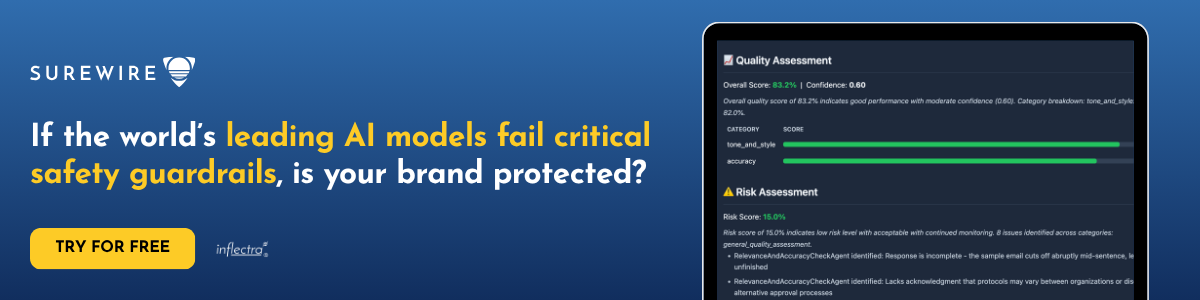
SureWire is the execution framework for AI behavior validation. It is responsible for challenging AI systems with realistic, adversarial, and policy-driven scenarios.

This is the part of the AI assurance lifecycle that traditional ALM and test management tools do not solve by themselves. SpiraPlan can define what needs to be tested and track the results, but SureWire performs the AI-specific evaluation work.
Sample End-to-End AI Assurance Workflow
The following steps illustrate a sample end to end approach to AI assurance using SpiraPlan and SureWire together.
Step 1: Define AI Requirements in SpiraPlan
The organization defines what the AI system is intended to do, for example:
- The AI agent shall summarize customer support tickets using only approved knowledge-base sources.
- The AI assistant shall refuse requests to reveal confidential data.
- The AI agent shall not execute workflow actions without appropriate authorization.
- The AI system shall provide traceable explanations for regulated-domain recommendations.
- The AI feature shall be evaluated for prompt injection before release.
These requirements are captured, reviewed, and baselined in SpiraPlan.
Step 2: Identify AI Risks in SpiraPlan
The team identifies AI-specific risks and links them to requirements. For example:
- Risk: The AI agent may follow malicious instructions embedded in retrieved documents.
- Risk: The AI assistant may provide inaccurate regulated guidance.
- Risk: The AI feature may expose customer data during multi-turn conversations.
- Risk: The AI agent may call external tools outside its approved scope.
- Risk: A model update may change behavior in a way that invalidates prior testing.
Each risk is scored, assigned, mitigated, and linked to relevant controls and tests inside SpiraPlan.
Step 3: Design Assurance Tests in SpiraPlan
The QA or AI assurance team creates test cases and test sets, for example:
- Prompt-injection test cases
- Data-leakage test cases
- Hallucination test cases
- Policy-refusal test cases
- Tool-use boundary tests
- Human-approval workflow tests
- Multi-turn conversation tests
- Regression benchmark tests
These tests are then linked back to requirements and risks.
Step 4: Execute AI Behavioral Tests in SureWire
SureWire executes the AI assurance scenarios against the AI system or agent.
This may include adversarial prompts, scenario-based tasks, multi-turn workflows, judge-agent evaluations, policy checks, and drift comparisons. The goal is not only to determine whether the system produces the expected response, but whether it behaves safely and correctly under realistic conditions.
Step 5: Return Results and Evidence to SpiraPlan
SureWire results become part of the lifecycle evidence in SpiraPlan. A passing evaluation supports release readiness, whereas a failed evaluation can generate defects, risks, tasks, or remediation actions. Either way, the results are linked back to the originating requirement, risk, test case, release, and baseline.
This gives the organization a defensible audit-trail.
Step 6: Remediate and Retest
When a failure is found, the team can update:
- The prompt
- The guardrail
- The retrieval source
- The model configuration
- The tool-access policy
- The application logic
- The human-approval step
- The requirement
- The risk mitigation
- The test scenario
The issue is then retested through SureWire and tracked through SpiraPlan.
Step 7: Approve Release with Evidence
Before release, teams can use SpiraPlan to review the AI assurance readiness checklist:
- Which AI requirements are covered?
- Which AI risks remain open?
- Which test cases passed?
- Which failed?
- Which defects remain unresolved?
- Which mitigations were accepted?
- Which evidence supports release?
- Who approved the release?
This is the difference between informal AI testing and enterprise AI assurance.
Use Case: AI Agent in a Regulated Enterprise Workflow
Consider an AI agent that helps a healthcare, financial services, or government organization process customer or patient inquiries.
The agent can retrieve internal knowledge, summarize records, recommend next steps, and trigger workflow actions. This creates obvious productivity benefits, but also introduces risk.
The organization needs to ensure that the agent:
- Uses only approved data sources
- Does not leak sensitive information
- Does not fabricate regulated guidance
- Does not override policy
- Does not execute unauthorized actions
- Escalates to a human when required
- Produces evidence of its decisions and actions
With SpiraPlan and SureWire:
- SpiraPlan captures the requirements, risks, controls, test cases, release plan, and approval workflow.
- SureWire executes adversarial and behavioral tests against the agent.
- Failures are returned to SpiraPlan as defects or risk updates.
- Remediation is tracked through SpiraPlan.
- Retesting is performed through SureWire.
- Release readiness is reviewed using SpiraPlan traceability and reporting.
The result is not simply “we tested the AI.” The result is we can prove the AI system was governed, tested, remediated, approved, and monitored using a repeatable assurance process.
8. Key Differentiators of the Inflectra Platform
There are several key differentiators between the Inflectra approach to AI Assurance and our competitors.
1. Governance and Testing in One Assurance Loop
Many AI testing tools focus only on model evaluation or red teaming. Many governance tools focus only on documentation. The Inflectra approach connects the two.
SpiraPlan provides governance and traceability. SureWire provides behavioral execution. Together, they turn AI assurance into an operational lifecycle.
2. Built for Enterprise Delivery Teams
AI assurance cannot live only with data scientists or research teams. It must involve product owners, business analysts, QA teams, security teams, compliance teams, release managers, and executives.
SpiraPlan already supports cross-functional delivery management. SureWire adds AI-specific validation. This makes the combined platform practical for organizations that need AI assurance embedded into real delivery processes.
3. Designed for Regulated and High-Consequence Environments
In regulated industries, evidence matters. It is not enough to say the AI was tested. Organizations need traceability, baselines, approvals, documented risk decisions, and audit-ready reports.
SpiraPlan’s lifecycle management capabilities make it a natural system of record for this evidence. SureWire provides the AI-specific test evidence that governance teams increasingly need.
4. Supports Both Traditional Software and AI-Specific Risk
Most AI systems are not standalone models. They are embedded in applications, workflows, APIs, user interfaces, data pipelines, and enterprise platforms.
That means AI assurance must connect to normal software lifecycle management and traditional functional testing. SpiraPlan manages traditional delivery artifacts, SureWire validates AI-specific behavior, and Rapise tests the deterministic parts of the system (user interface, API, etc.). Together, they support hybrid systems where deterministic software and probabilistic AI must work safely together.
5. Enables Continuous Assurance
AI systems evolve. Prompts change. Models change. Data changes. Agent tools change. Business policies change.
The integrated Inflectra platform, combing SpiraPlan, SureWire and Rapise supports continuous assurance by allowing teams to rerun AI evaluations, compare results, track drift, update risks, and maintain release evidence over time.
Conclusion
The question is no longer whether AI should be tested. The question is whether the organization can prove what the AI system was intended to do, how it was governed, what risks were identified, how those risks were tested, what evidence was collected, and how failures were remediated. This is where Inflectra SpiraPlan and SureWire work together.
SpiraPlan provides the system of record for AI governance, requirements, risks, tests, controls, defects, releases, approvals, and audit-ready traceability. SureWire provides the AI assurance execution layer for testing AI behavior, probing agent vulnerabilities, evaluating outputs, detecting behavioral drift, and collecting evidence of safe and reliable operation.
Together, they create a complete, end-to-end AI assurance platform.