Free Business Requirements Document (BRD) Template & Example for Agile Teams
Before teams begin defining features, workflows, or technical specifications, there’s a more fundamental question to answer. What does the business actually need to accomplish, and why is the initiative worth pursuing? A Business Requirements Document captures that higher-level context so stakeholders have a shared record of the problem or opportunity, the outcomes the organization is pursuing, the boundaries of the initiative, and the requirements that must be satisfied for the effort to deliver value.
This article includes a free BRD template you can download to organize that information before an initiative moves into detailed planning and execution.
For those looking for a narrower template to define features, user stories, and other project-level requirements, see our resource: Product Requirements Document (PRD) Template & Example
What is a Business Requirements Document (BRD)?
A BRD is a high-level document that defines the business need behind an initiative and records the requirements, stakeholders, scope, and other context needed to guide it. The emphasis is on the business, rather than the detailed design of a particular solution. Stakeholder and solution requirements add progressively more detail beneath that business layer.
For example, a BRD might establish that an organization needs to reduce the time required to process customer claims, consolidate several disconnected internal systems, or improve regulatory reporting. It doesn’t necessarily prescribe every screen, feature, workflow, or technical implementation needed to accomplish that change. The BRD provides the business-level foundation that the more detailed requirements (such as your Product Requirements Document mentioned above) should be able to trace back to.
What is the Purpose of a Business Requirements Document?
The main objective of a BRD is to align on what the business needs before significant time, budget, and resources are committed to delivering a solution. This isn’t just another document to complete at the beginning of a project — it gives stakeholders a reference point for making decisions throughout the initiative. A strong BRD can help an organization:
- Determine whether an initiative is worth pursuing: Documenting the business problem, expected outcomes, value, risks, and constraints gives decision-makers more information to evaluate the proposed investment before execution begins.
- Prevent teams from solving different versions of the same problem: Business leaders, analysts, product teams, developers, and other stakeholders may enter an initiative with different assumptions, so the BRD establishes an agreed-upon starting point.
- Control scope before it expands: Clearly documenting what is and is not part of the initiative makes it easier to evaluate new requests against the original business need instead of automatically adding them to the work.
- Give downstream requirements a reason to exist: Product features and solution requirements should ultimately support a business outcome. Connecting them back to documented business requirements makes it easier to identify work that does not contribute to the original need.
- Create criteria for evaluating the result: Instead of asking only whether the project was delivered, stakeholders can return to the BRD and ask whether the change actually addressed the business problem it was intended to solve.

Key Components of a BRD for Agile Environments
The exact structure of a Business Requirements Document can vary by organization and initiative. However, an effective BRD should include enough context to explain the business need, establish its boundaries, identify the people affected, and connect individual requirements to the outcomes the organization expects. Our BRD template organizes that information into the following components:
|
Component |
What it is/does |
|
Project / Initiative Information |
Basic identifying information such as the initiative name, document owner, version, date, and approval status. |
|
Executive Summary |
A short overview of the initiative, the business need behind it, and the change being considered. |
|
Business Problem or Opportunity |
The issue, unmet need, or opportunity prompting the organization to act. |
|
Current State |
How the relevant process, system, or business function works today and where significant gaps exist. |
|
Desired Future State |
A high-level description of what should be different once the business need has been addressed. |
|
Business Objectives & Success Measures |
The business outcomes the initiative should contribute to and the measures used to evaluate progress or success. |
|
Stakeholders |
The sponsors, business groups, subject-matter experts, users, decision-makers, and other parties affected by or involved in the initiative. |
|
Scope |
The organizational processes, systems, teams, locations, or areas included in the initiative, as well as important exclusions. |
|
Business Requirements |
High-level statements describing what the business needs to achieve, independent of unnecessary implementation detail. |
|
Business Value / Expected Benefits |
The expected business impact of satisfying the requirements, such as reduced cost, lower risk, improved efficiency, increased revenue, or better customer outcomes. |
|
Assumptions & Constraints |
Conditions assumed to be true and known restrictions involving factors such as budget, policy, regulations, technology, resources, or timing. |
|
Dependencies |
Other systems, teams, initiatives, vendors, decisions, or events that the proposed change depends on. |
|
Risks |
Business, operational, schedule, technical, compliance, or other uncertainties that could affect the initiative or its expected value. |
|
High-Level Milestones |
Major decision points, target dates, approvals, or stages that provide context for the initiative without becoming a detailed project schedule. |
|
Approvals & Change History |
A record of who has reviewed or approved the BRD and how the agreed requirements have changed over time. |
Business Requirements Document Template: Download Here
Below, we’ve included a business requirements document template that’s free for download to get your team up and running in no time:
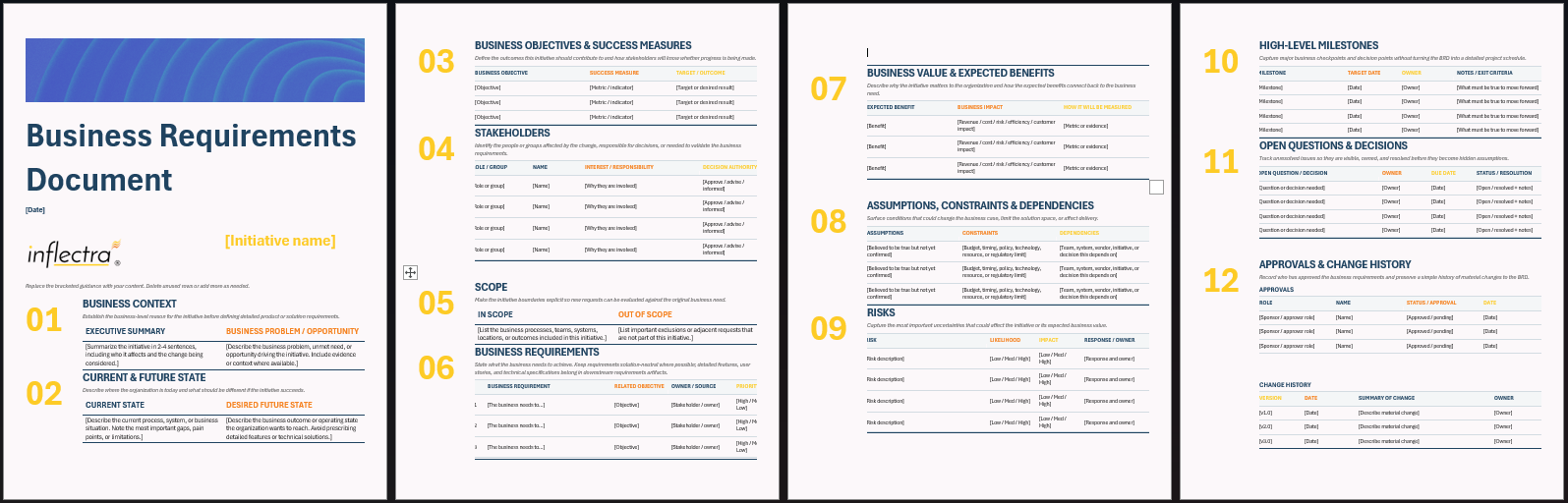
Download our pre-built business requirements document template here:
Benefits of a BRD Template Like Ours
You can create a BRD in a blank spreadsheet or document, but the hardest part usually isn't formatting the file. Instead, it's deciding what information belongs in the BRD, what level of detail should be captured, and how each piece of information relates to the business decision being made. Our template helps you:
- Separate the business need from the proposed solution: Starting with dedicated fields for the problem, current state, desired state, and business requirements makes it less likely that teams will jump straight to features before agreeing on what actually needs to change.
- Connect requirements to business outcomes: A structured requirements register can associate individual business requirements with objectives, stakeholders, priorities, and expected value instead of leaving requirements as an isolated list.
- Set boundaries explicitly: Dedicated scope, constraint, assumption, and dependency fields make important limitations visible rather than leaving them buried in meeting notes or stakeholder conversations.
- Capture the context behind requirements: Recording the source, rationale, owner, and business value of a requirement makes it easier to understand why it exists when questions or change requests arise later.
- Keep the BRD at the right altitude: The prompts encourage business-level requirements instead of allowing the document to gradually turn into a collection of user stories, product features, and technical specifications.
- Create a cleaner handoff to detailed requirements management: Once the business case and requirements are agreed upon, the structured information in the BRD provides a stronger starting point for developing program capabilities, product requirements, PRDs, releases, and other downstream work.
Business Requirements Document Example: Loan-Origination Efficiency & Compliance
A regional bank currently manages parts of its commercial loan-origination process across an aging internal application, spreadsheets, email, and manual approval steps. It wants to modernize the system so loan teams can process applications more consistently, maintain a clear record of approvals and changes, reduce manual handoffs, and give compliance teams better visibility into the process.
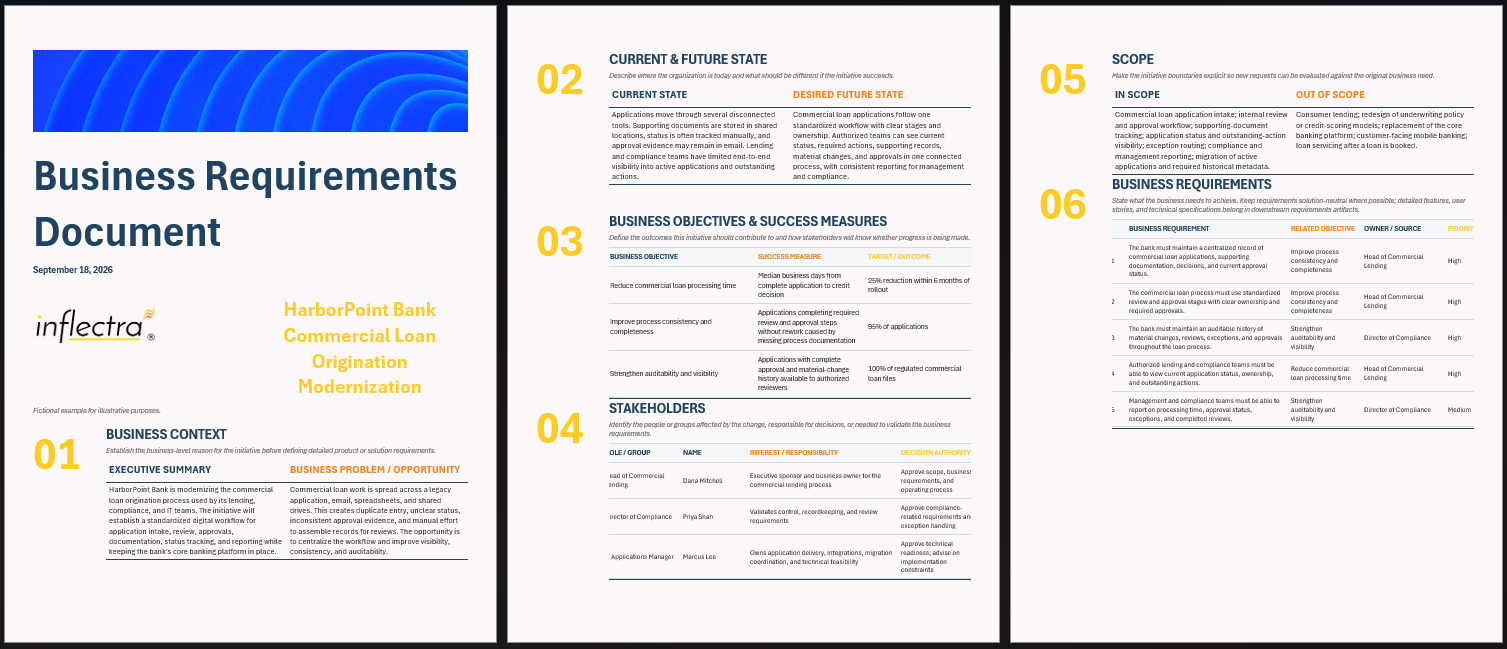
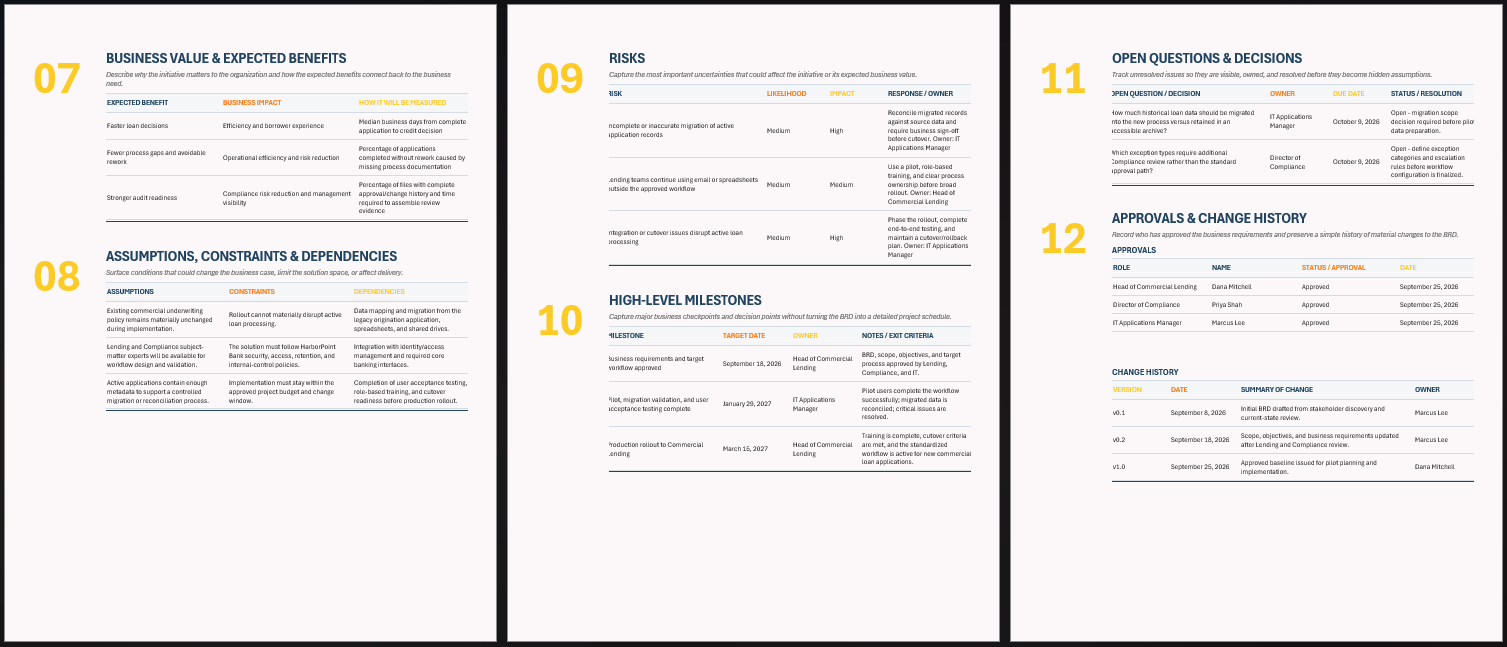
Below, we’ve filled out the same template document we provided above with sample information for this scenario:
|
BRD Component |
HarborPoint Bank Sample Data |
|
1. Business Context |
Initiative: Commercial Loan Origination Modernization. HarborPoint wants to modernize the process used by Lending, Compliance, and IT. Commercial loan work currently spans a legacy application, email, spreadsheets, and shared drives, creating duplicate entry, unclear status, inconsistent approval evidence, and manual review preparation. |
|
2. Current & Future State |
Current: Applications move through disconnected tools. Documents and approvals are scattered. Status is often tracked manually. Future: One standardized process with clear stages and ownership, centralized records, visible outstanding actions, and consistent reporting. |
|
3. Business Objectives & Success Measures |
Reduce processing time: 25% reduction in median days from complete application to credit decision. Improve consistency: 95% of applications complete required review/approval steps without rework caused by missing documentation. Strengthen auditability: 100% of applicable commercial loan files have complete approval and material-change history available to authorized reviewers. |
|
4. Stakeholders |
Dana Mitchell (Head of Commercial Lending): Executive sponsor/business owner. Priya Shah (Director of Compliance): Validates control and review requirements. Marcus Lee (IT Applications Manager): Owns application delivery, integrations, migration, and technical readiness. |
|
5. Scope |
In scope: Commercial loan intake, internal review/approval, supporting-document tracking, status visibility, exception routing, compliance/management reporting, and migration of active applications. Out of scope: Consumer lending, underwriting-policy redesign, core banking replacement, mobile banking, and servicing after booking. |
|
6. Business Requirements |
BR-01: Centralized record of applications, documents, decisions, and approval status. BR-02: Standardized review/approval stages with clear ownership. BR-03: Auditable history of material changes, exceptions, reviews, and approvals. BR-04: Authorized teams can see current status, ownership, and outstanding actions. BR-05: Management and Compliance can report on processing time, status, exceptions, and completed reviews. |
|
7. Business Value & Expected Benefits |
Faster decisions: Measured by median application-to-decision time. Less rework: Measured by applications completed without process-documentation rework. Stronger audit readiness: Measured by completeness of approval/change history and effort required to assemble review evidence. |
|
8. Assumptions, Constraints & Dependencies |
Assumptions: Underwriting policy remains materially unchanged. SMEs are available. Active records contain sufficient migration data. Constraints: No major disruption to active loan processing. Bank security/access/retention policies must be followed. Implementation must stay within the approved budget/change window. Dependencies: Data migration, identity/access and core-system integrations, UAT, training, and cutover readiness. |
|
9. Risks |
Migration errors (Medium/High): Reconcile records and require business sign-off. Low adoption (Medium): Pilot, training, and clear process ownership. Integration/cutover disruption (Medium/High): Phased rollout, end-to-end testing, and rollback plan. |
|
10. High-Level Milestones |
Sept. 25, 2026: Business requirements and target workflow approved. Jan. 29, 2027: Pilot, migration validation, and UAT complete. Mar. 15, 2027: Production rollout to Commercial Lending. |
|
11. Open Questions & Decisions |
1: How much historical loan data should be migrated versus retained in an accessible archive? 2: Which exception types require additional Compliance review rather than the standard approval path? |
|
12. Approvals & Change History |
Approvals: Dana Mitchell, Priya Shah, and Marcus Lee v0.1: Initial draft from stakeholder discovery v0.2: Scope/objectives/requirements updated after Lending and Compliance review v1.0: Approved baseline issued for pilot planning and implementation. |
How to Write a Business Requirements Document
A BRD is most valuable when stakeholders can use it to make decisions, not just when all of the fields have been filled out. Keep the following practices in mind as you build yours:
- Start with the business problem, not the requested solution: “We need a new CRM” is already a proposed answer. First document the problem the organization is trying to solve, such as fragmented customer data or excessive manual work.
- Write requirements in terms of business needs: Focus on what the organization must be able to accomplish. Save detailed interfaces, system behaviors, user stories, and technical specifications for downstream requirements.
- Make outcomes measurable where possible: Replace broad goals such as “improve efficiency” with a metric or observable outcome that stakeholders can later evaluate.
- Give every requirement a reason to exist: Tie requirements back to a business need, objective, stakeholder, or expected benefit. If a requirement cannot be connected to the purpose of the initiative, reconsider whether it belongs.
- Define what is out of scope as carefully as what is in scope: Explicit exclusions help prevent adjacent requests from quietly expanding the initiative.
- Gather requirements collaboratively: Sponsors, operational teams, subject-matter experts, end users, compliance teams, and delivery teams may see different parts of the business problem. Bring the relevant perspectives together before treating the BRD as complete.
- Separate facts from assumptions: If a requirement or decision depends on something that has not been validated, identify it as an assumption so it can be revisited later.
- Record dependencies and risks early: Requirements rarely exist in isolation. External systems, other programs, regulations, vendors, budgets, and organizational changes can all affect whether a business requirement can be satisfied.
- Prioritize rather than treating every requirement as equally critical: Prioritization helps stakeholders distinguish requirements essential to the business outcome from desirable additions that may be negotiable.
- Treat the BRD as a living reference while decisions are being made: Update requirements, assumptions, scope, and decisions as they change, and maintain a record of significant revisions rather than allowing several conflicting versions of the document to circulate.
Upgrade Your Organization’s Requirements Management with Inflectra
A BRD template is a useful way to establish the business need and organize requirements at the beginning of an initiative. But as the work grows, a spreadsheet or document has an important limitation — it’s still static while the initiative around it evolves. At that point, maintaining the connection between the original business need and the work actually being delivered becomes much harder than simply maintaining the BRD itself.
SpiraPlan is designed for that next stage. Organizations can define strategic outcomes at the portfolio level to represent major business goals or enterprise priorities and connect them to the program capabilities required to realize them. Those program-level capabilities can then be associated with the product requirements responsible for delivering the work, creating a traceable path from high-level strategy toward execution. Portfolio and program milestones provide corresponding planning checkpoints across those layers. Instead of leaving business objectives in one document, requirements in another, risks in a spreadsheet, and delivery work in separate project tools, organizations can connect those artifacts within the same management environment.
Start with our BRD template to define what your organization needs, then start a free trial of SpiraPlan to keep those requirements connected as the initiative moves from business planning to execution.