Agentic Software Delivery with Inflectra AI
The rise of frontier Large Language Models (LLMs) such as Anthropic Claude, and agentic software development harnesses such as Claude Code, Amazon Kiro and OpenAI Codex have fundamentally changed how software is specified, developed, verified and released. In the same way that the agile manifesto transformed software delivery in the 2000s, AI-native software development, often called the Agentic SDLC or the Software Factory will require a completely new software methodology and set of tools fit for the AI era.
This whitepaper provides a practical model for AI-native software delivery using spec-driven development, MCP, and autonomous testing to provide a blueprint for delivering enterprise-grade software at speed and scale. This new Agentic SDLC is an AI-native software delivery model in which specifications, tools, and execution contexts are exposed to agents through open interfaces such as MCP, enabling semi-autonomous or autonomous design, coding, testing, and deployment under human governance.
Agile and DevOps
The original impetus for the move to agile methodologies and DevOps was to reduce the time from a new idea being conceived and a working prototype version of that idea being delivered to a customer or stakeholder to get feedback. This replaced the older, waterfall methodologies that prioritized writing and defining requirements, defining formal acceptance criteria and longer phases of development and testing.
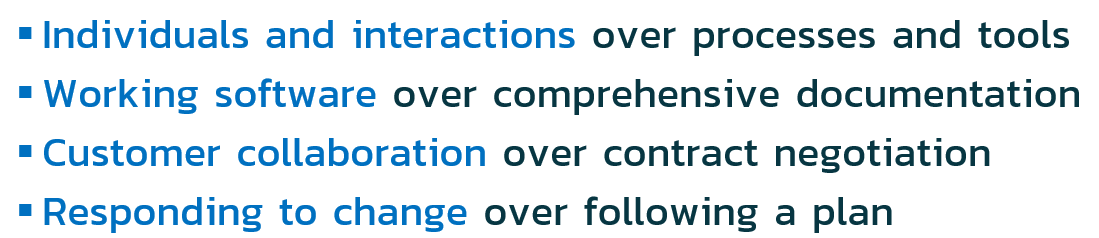
Specifically agile methodologies such as Scrum, Kanban and Extreme Programming eschewed formal requirements in favor of lightweight user stories, de-emphasized formal documentation in favor of real-time communications between stakeholders, users and the product team, and replaced standalone QA teams with integrated multi-disciplinary agile teams. The bottleneck had typically been development and testing, and by shortening this cycle, customers could give feedback more quickly, and the team could delivery value more rapidly in smaller increments.
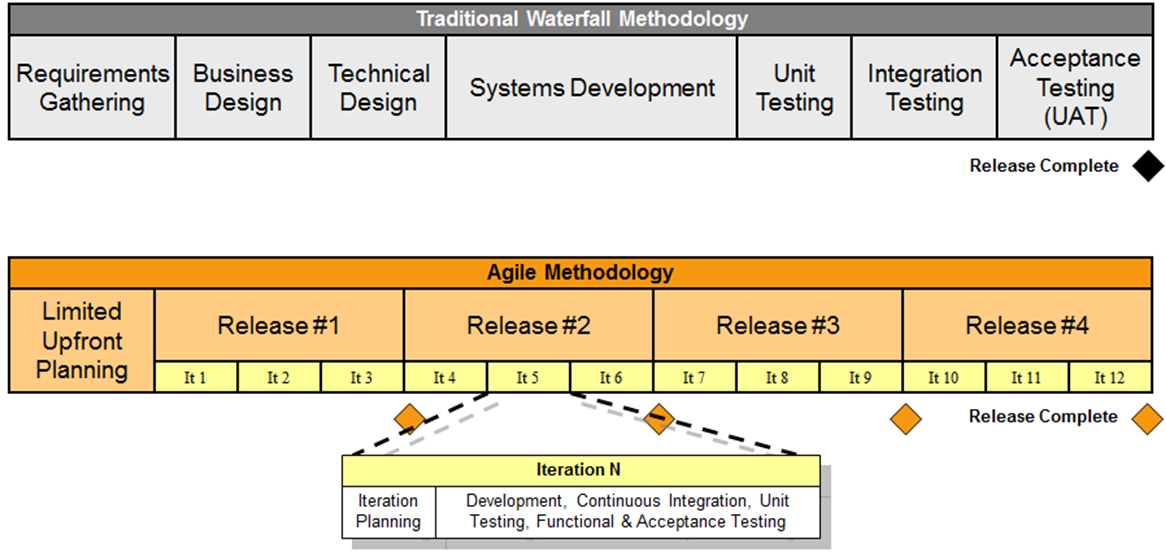
With the availability of cloud platforms such as AWS, GCP and Azure and new approaches such as Infrastructure a Code and Continuous Integration & Continuous Deployment (CI/CD) pipelines, the infrastructure bottleneck was bypassed, heralding the era of DevOps.
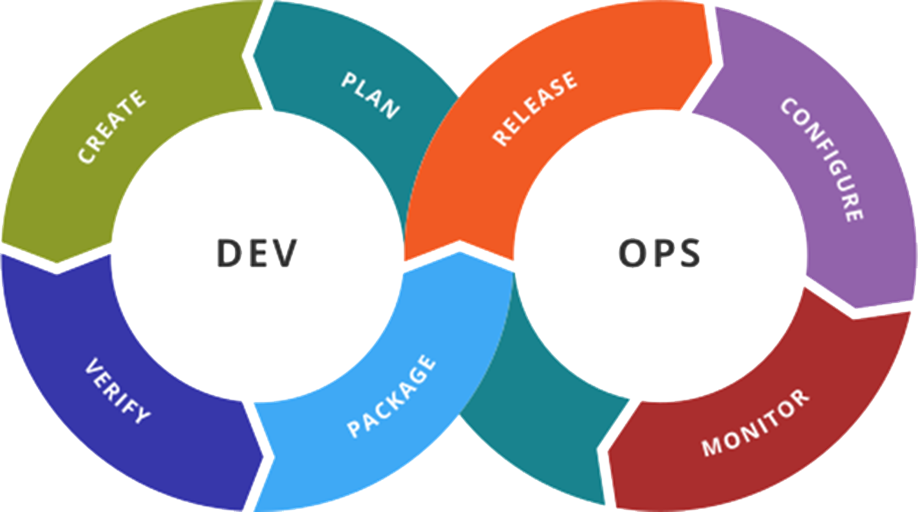
As part of the DevOps revolution, teams aimed to “shift-left” and do more testing and verification prior to code being written, and “shift-right” and have continuous monitoring, so that errors in production would be caught more quickly, and rollbacks of production issues would be possible.
Due to the combination of Agile and DevOps, there was an increased emphasis on tools, automated processes and code becoming more important than ever. However ultimately the writing of requirements, creating of code, scripting of automated tests, performing code reviews, and monitoring production was still a largely human endeavor.
Impact of Artificial Intelligence
Artificial Intelligence (AI) is not new - XCON, the first production AI was released in 1980, IBM Watson was released in 2011, and even the Transformer (the “T” in GPT) architecture was developed as far back as 2017. However, until the public release of ChatGPT 3.5 on November 2022, the use of AI and more generally Machine Learning (ML) was confined to data scientists and other AI/ML professionals. In the same way that the Internet existed in various forms since 1969, until the first web browser (NCSA Mosaic) was introduced in 1993, it was not used outside of academia and research institutions.
With the launch of ChatGPT 3.5, followed closely after by Microsoft “copilot” assistants in Office365 and its development platforms (Visual Studio, Azure DevOps, and GitHub), AI finally because a general-purpose tool available for consumers, businesses and application developers. Within a year of its introduction, the traffic to popular software development community sites such as Stack Overflow fell 95%:
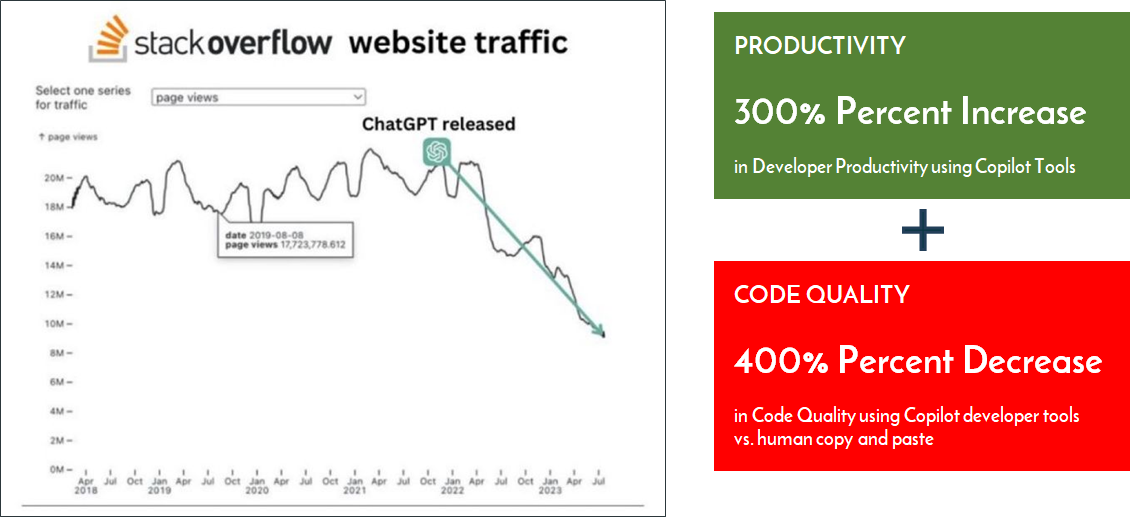
Instead of using StackOverflow and similar sites, developers were simply asking ChatGPT, Gemini, or Copilot how to solve a specific problem and then using the suggested code in their development environment (known as an IDE or integrated development environment). However, as illustrated above, studies found that productivity in term of code quantity was increasing, but a corresponding decrease of code quality was also being experienced.
Introducing Coding Harnesses
One of the central problems from the AI coding assistant era was that being able to generate code is not the same as being able to engineer software autonomously. Early AI coding assistants such as Copilot could produce convincing code snippets, but struggled with completing complex, multi-step engineering assignments without continuous human intervention.
The introduction of autonomous coding agents such as Claude Code, Amazon Kiro and OpenAI Codex in 2023 changed the nature of software development. Instead of simply responding to prompts with code suggestions, these systems combine powerful large language models with an execution environment that allows them to inspect repositories, modify files, run tests, diagnose failures, and iteratively develop complete solutions. A coding harness typically handles tool execution, context management, iterative workflows, permissions, feedback, and connections to external systems.
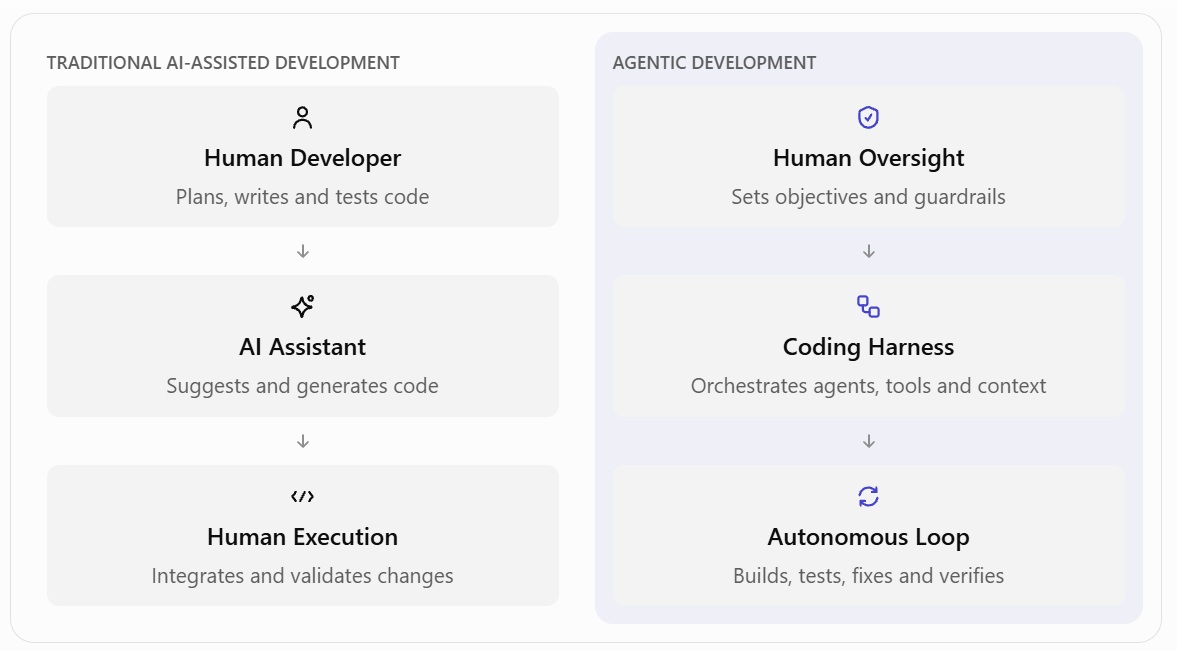
However, this move to agentic development fundamentally changes the roles. Previously the human software developer was in the “pilot” seat, with the AI assistant in a supporting role, hence the terminology “copilot”. With the move from assistants to harnesses, the AI is now firmly in the drivers’ seat:
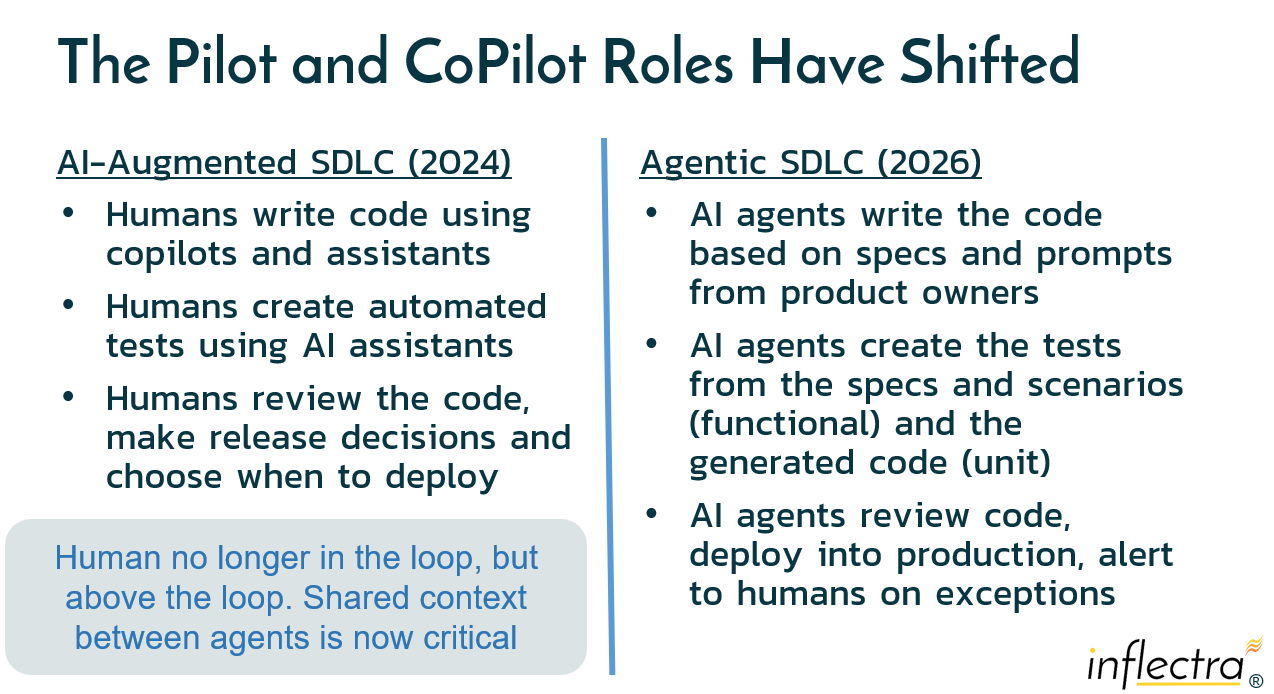
These coding harnesses overcome the limitations of standalone language models. An LLM may possess considerable programming knowledge, but it lacks the project context, operational tools, persistent state, and feedback mechanisms necessary to reliably execute complex software engineering tasks. By surrounding the model with these capabilities, coding harnesses transform generative AI from a passive development assistant into an increasingly autonomous software engineering agent.
However, the one missing piece was how to connect the coding harness and LLM to the wider Software Development Life Cycle (SDLC); step forward the Model Context Protocol (MCP) introduced by Anthropic in 2024.
The Model Context Protocol
The Model Context Protocol (MCP), introduced by Anthropic, defines a standardized interface for supplying structured, real-time context to LLMs, lets you call APIs, as well as access files, database rows and other resources.
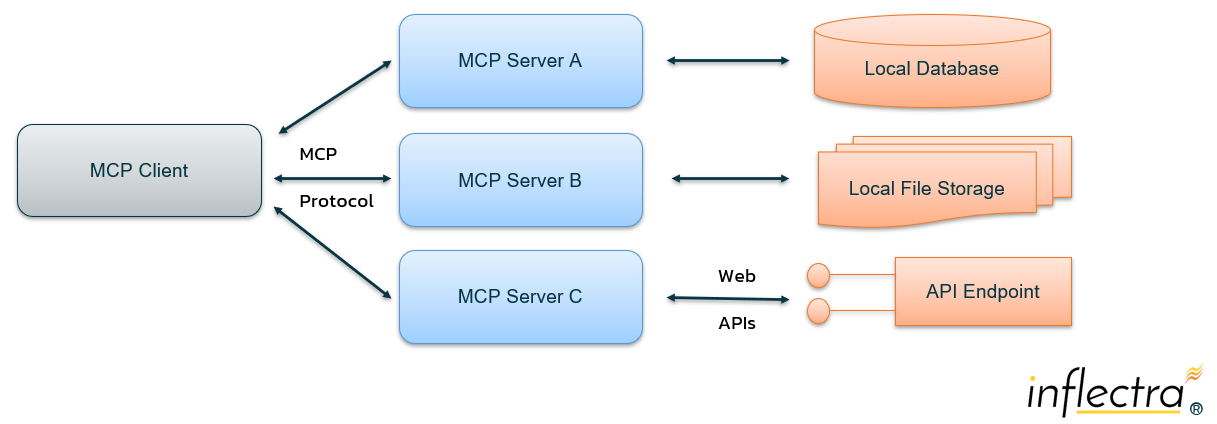
At the time of MCP’s introduction, AI coding assistants, editors, and agent runtimes already wrapped models in execution loops, file/shell tools, context management, and custom tool-calling integrations, however they typically relied on their own custom tool-calling protocols and wiring.
MCP changed this by allowing coding harnesses such as Claude Code, OpenAI Codex, and Amazon Kiro to interact with requirements management platforms, testing tools, project management systems, databases, and deployment pipelines through a common protocol. This transformed AI coding agents from sophisticated code-generation tools into increasingly autonomous software engineering systems capable of understanding business requirements, implementing changes, executing tests, managing defects, and coordinating activities across the entire software development lifecycle.
By connecting AI reasoning with enterprise knowledge and operational tools, MCP helped accelerate the transition from AI-assisted coding to the Agentic SDLC, where AI agents can orchestrate complex development workflows while humans provide strategic direction, governance, and oversight.
The Agentic SDLC
The Agentic Software Development Lifecycle (Agentic SDLC) represents a fundamental shift in how software is designed, built, tested, deployed, and maintained. Instead of humans performing each activity with assistance from AI tools, autonomous AI agents increasingly orchestrate and execute the entire lifecycle, from ideation and requirements definition through development, verification, deployment, and production monitoring.
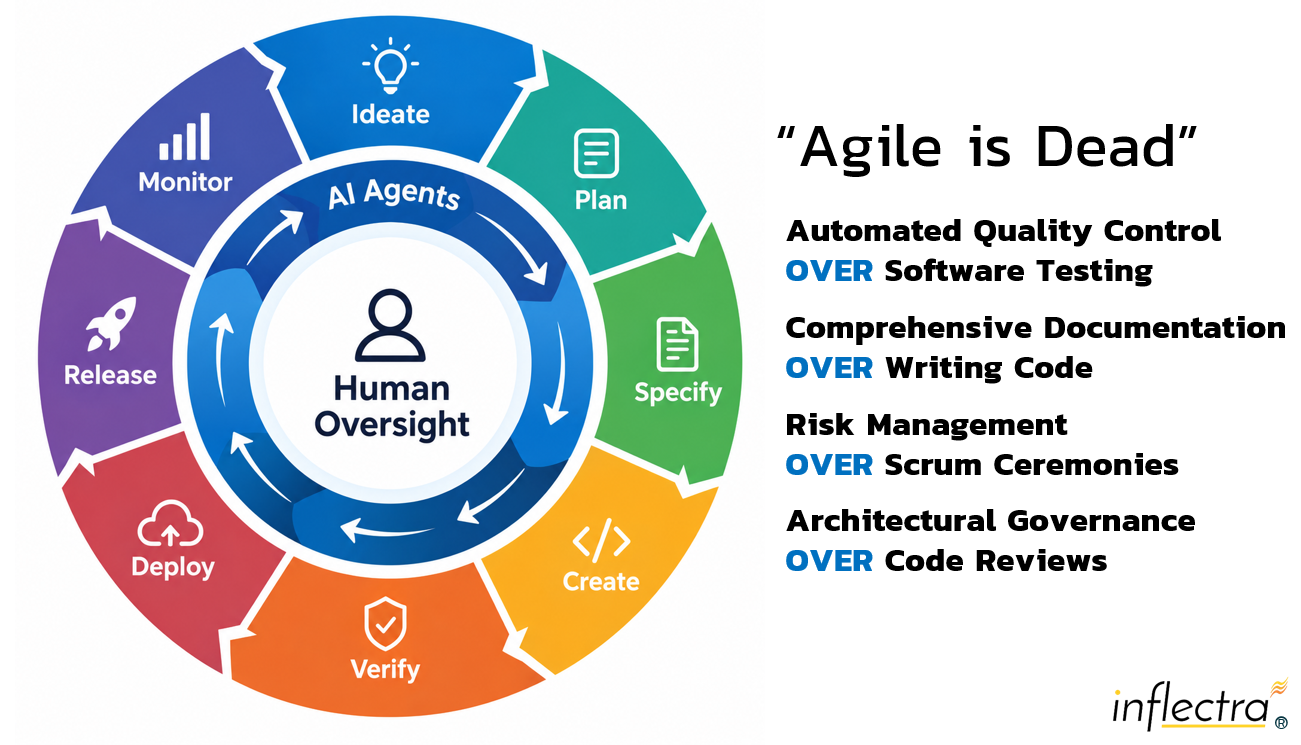
Powered by advanced large language models, coding harnesses, and MCP, these agents can access enterprise knowledge, collaborate across specialized tools, make decisions, and continuously adapt based on feedback.
A key change from the previous agile and DevOps diagrams is that every stage in the cycle is being performed autonomously or semi-autonomously by an AI agent. In this methodology, humans are for the most part not “in the loop” itself, but instead “outside of the loop”, monitoring the end-to-end software delivery lifecycle, but not bottlenecking individual actions.
For many organizations, this represents a completely different way of building software, with the creation of software moving from a human-centric “craft industry” to a repeatable, automated process from ideation to deployment, akin to a factory or production line. This has given rise to the term “software factory”.
The Software Factory
The “software factory” is an approach to software engineering that treats software delivery as a repeatable, automated production system rather than a collection of individual development activities. In its modern AI-driven form, autonomous agents perform specialized tasks such as requirements analysis, coding, testing, security verification, deployment, and monitoring, coordinated through standardized workflows and quality controls.
The Agentic SDLC and the software factory are closely related concepts, but they operate at different levels. The Agentic SDLC describes how autonomous AI agents execute activities across the software development lifecycle, from ideation and requirements definition through coding, testing, deployment, and monitoring, with continuous quality assurance and human oversight.
The AI Software Factory takes this concept further by orchestrating multiple AI agents, coding harnesses, and enterprise systems into a coordinated, scalable production environment that can deliver software continuously and predictably. In essence, the Agentic SDLC defines how autonomous software development works, while the AI Software Factory defines how organizations industrialize and scale that process, transforming business requirements into production-ready software through repeatable, governed, and increasingly autonomous workflows.
This comparison is illustrated in the diagram below:
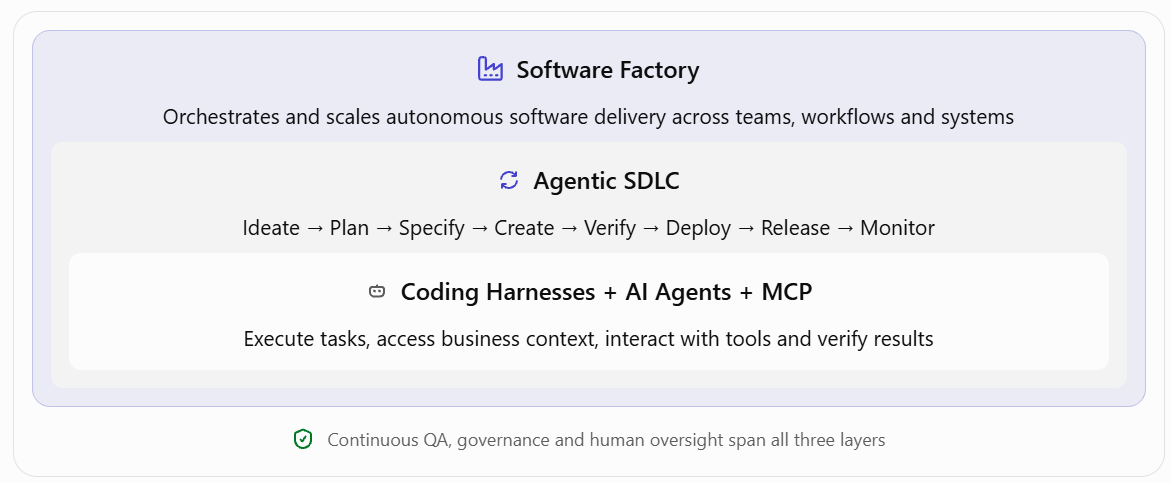
The Risk-Adaptive Software Factory.
A lot of analysts and experts in the software industry have been talking about “lights out” or “dark” software factories, where there is minimal human involvement in the SDLC, however this misses a key point - not every software change requires the same level of human involvement.
Just as a modern manufacturing facility might operate autonomously when producing standardized, low-risk components but require intensive human supervision for safety-critical operations, a software factory should also adjust its autonomy according to the risk of what it is building. For example developing an e-commerce website is not the same level of risk as building an embedded software system for flight control systems or medical devices. Therefore, it makes more sense to talk about a Risk Adaptive Software Factory than one that is purely “dark” or “lights out”.
There are levels of software factory, depending on the risk of what is being created:
1. Lights-Out Factory (Low risk)
Fully autonomous execution
AI agents plan, develop, test, and deploy software without routine human intervention. Automated QA agents continuously verify compliance with predefined policies and acceptance criteria. Humans monitor outcomes asynchronously and intervene only when exceptions occur.
Examples: Documentation updates, low-impact UI changes, isolated internal tools, and well-understood maintenance tasks.
2. Supervised Factory (Medium risk)
Autonomous execution with human checkpoints
AI agents perform most development activities autonomously, but human engineers review significant architectural decisions, security-sensitive changes, and production releases. Continuous QA provides the evidence needed for informed human approval.
Examples: Customer-facing business applications, significant feature changes, new integrations, and moderate-risk enterprise workflows.
3. Human-Controlled Factory (High risk)
Human-directed, AI-executed
AI agents still handle much of the engineering work, but human experts actively supervise critical activities, approve consequential decisions, review verification evidence, and authorize deployment. Independent QA and formal risk assessments provide additional assurance.
Examples: Medical software, aviation systems, financial transaction platforms, and safety-critical or highly regulated applications.
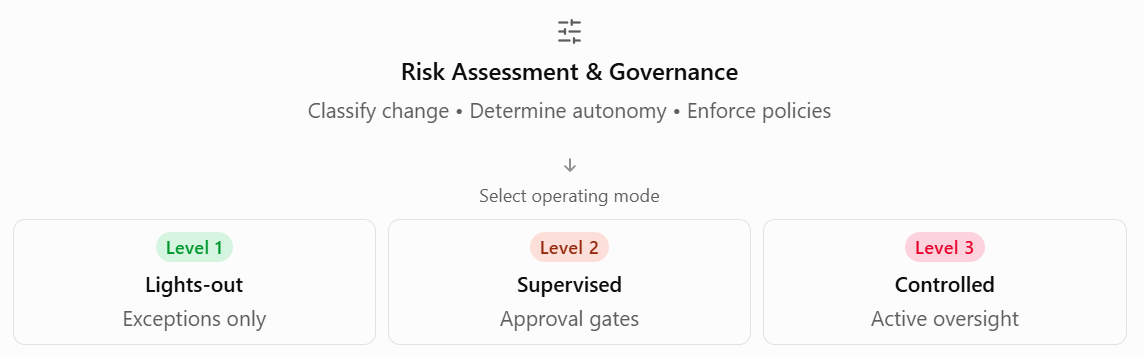
The interesting part is that - unlike a physical manufacturing facility - the autonomy level should not necessarily be fixed for an entire application or project. For example, an AI Software Factory developing a banking application might operate at Level 1 when updating documentation, Level 2 when adding a reporting dashboard, and Level 3 when modifying payment authorization logic.
In addition, these factors should be evaluated continuously rather than only at the beginning of the project. For example, an agent might begin implementing a Level 1 change but discover that it requires modifying a security-critical shared library. The factory should automatically escalate the work to Level 2 or Level 3 before proceeding.
One important qualification: lights-out must never mean assurance-free. In fact, Level 1 may require especially reliable automated controls because no person is routinely checking the work. Similarly, highly regulated systems may require mandatory human approvals regardless of how low an AI model estimates the risk to be.
The Importance of Shared Context
As autonomous or semi-autonomous AI agents increasingly take responsibility for the software development lifecycle, shared context becomes one of the most valuable assets in the software factory. While large language models provide intelligence and coding harnesses enable autonomous execution, agents still need a common understanding of business requirements, priorities, architecture, risks, and acceptance criteria to ensure they are building the right software.
Shared context becomes critical in the software factory model, for example, imagine three AI agents working on the same banking application: one agent is defining a new payment feature, another is implementing the feature, and yet a third is developing and executing the tests. If these agents rely exclusively on their own prompts, repository files, and local working memory, they may each develop a different understanding of the business requirements.
This is where systems of record such as Inflectra's Spira become critical, providing an authoritative source of lifecycle information that can be accessed and updated by multiple AI agents through MCP, as illustrated below:
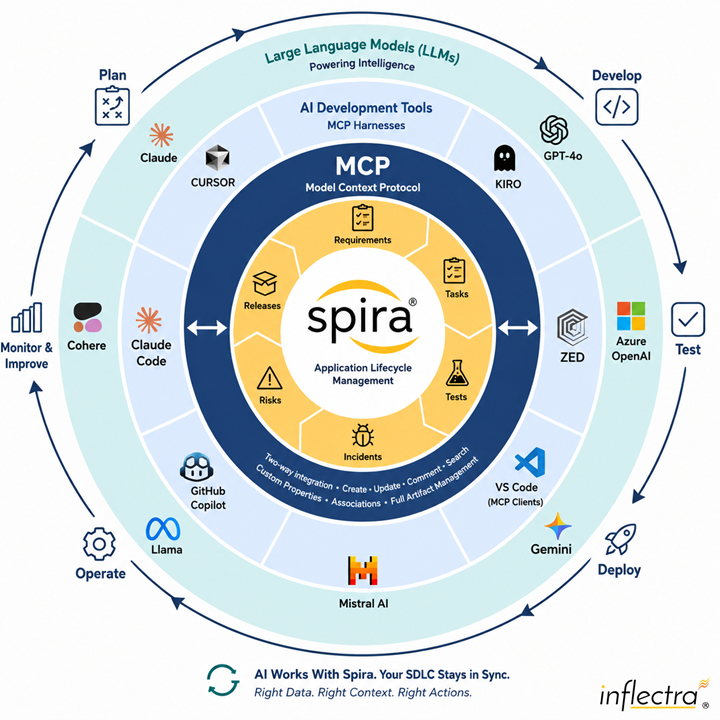
By connecting business intent with development activities, verification evidence, and governance policies, Spira can serve as the foundation of a shared context and lifecycle control plane, ensuring that autonomous agents remain aligned with organizational objectives.
Quality Assurance in the Factory
Much like a traditional manufacturing factory, business requirements and strategic objectives become the inputs, while verified, production-ready software becomes the output. However, unlike conventional manufacturing, the factory continuously learns and adapts as requirements evolve, defects are identified, and operational feedback is received.
Crucially, just like many advanced manufacturing facilities that practice ISO:9001, continuous Quality Assurance (QA) needs to be embedded throughout the software delivery lifecycle, with specialized AI agents and automated controls validating each stage before work progresses to the next.
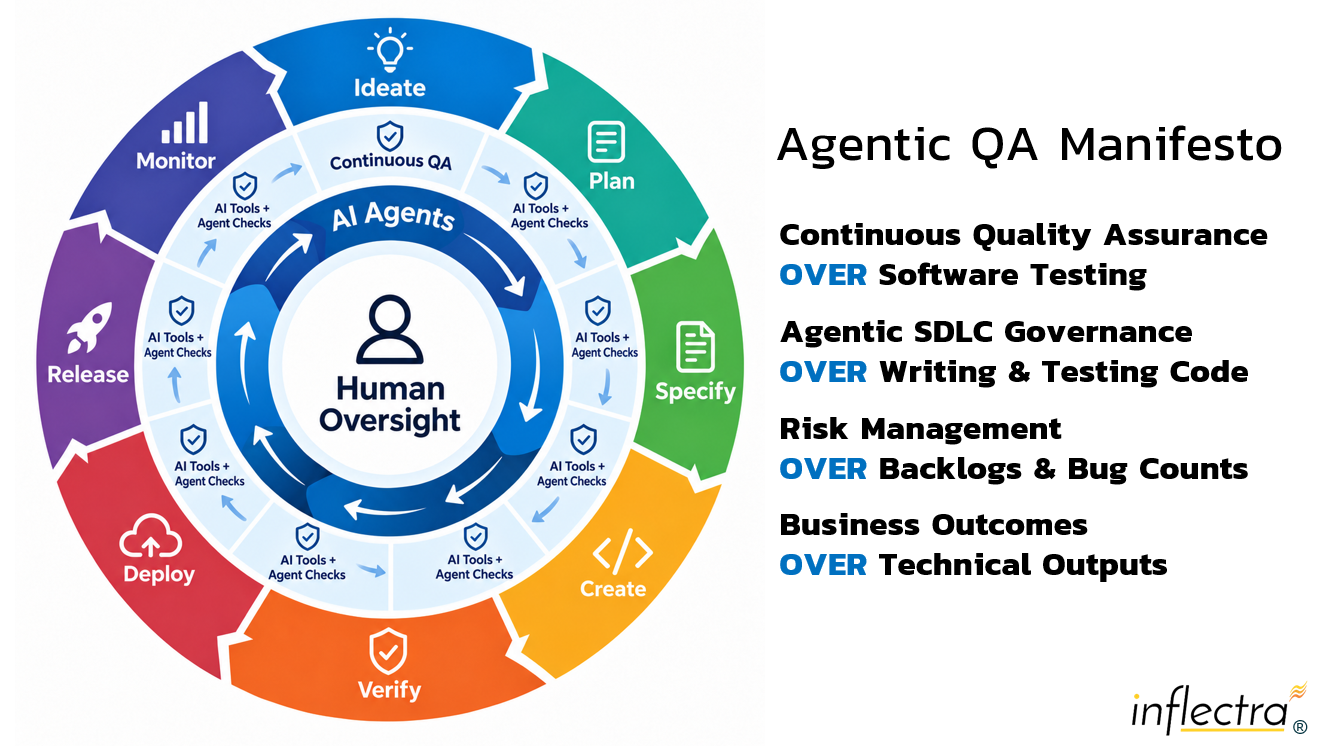
In this new paradigm, humans move from directly executing development activities to providing strategic direction, defining business objectives, establishing governance and risk boundaries, and exercising oversight over an increasingly autonomous software delivery process.
As described above, depending on the risk-level of the particular piece of work, the degree of autonomy will be determined and the level (and method) of human oversight calibrated accordingly. However, even in the highest risk category, the volume of requirements being generated and code written means that manual processes like code review, writing unit and end-to-end tests will need to be fully automated.
This is a fundamental change in how we think of quality. Traditionally the role of “QA” in software delivery has been to focus on “testing”. In the agentic SDLC, testing is continuous and will be done at every step of the process. Testing will become an automated process, but quality will still be a very human concern.
Inflectra.ai, Spira & Rapise
As software development evolves toward increasingly autonomous AI-driven processes, organizations need more than powerful coding agents. They need an integrated platform that connects business intent, artificial intelligence, and automated execution while maintaining continuous quality assurance, traceability, and governance.
Inflectra brings these capabilities together through three complementary systems: Spira as the System of Record, Inflectra.ai as the System of Intelligence, and Rapise as the System of Action.
Spira provides the authoritative business context and lifecycle information that guides the factory, Inflectra.ai applies intelligent reasoning and agentic automation to analyze information and coordinate activities, and Rapise translates quality objectives into automated testing and real-world verification. Working together, these technologies create a continuous feedback loop connecting requirements, decisions, actions, and evidence, helping organizations move toward a risk-adaptive autonomous software factory where AI agents perform much of the work while humans retain appropriate oversight and control.
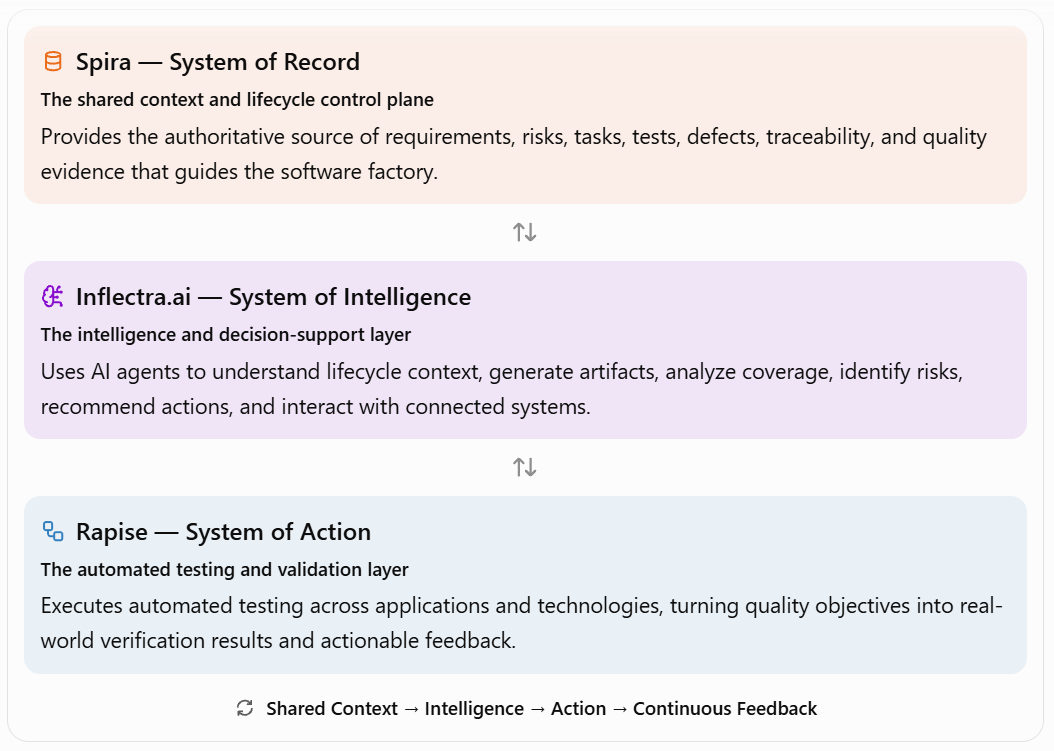
Rapise is specifically the system of action for testing and quality verification, rather than the execution engine for every software factory activity. Coding harnesses such as Kiro, Claude Code, and Codex remain responsible for much of the software implementation.
If we look at the new Agentic SDLC, it is critical that Spira should not simply be used to provide upfront requirements to coding agents at the beginning of development and collect test results at the end. Instead for a truly agentic software delivery process, it should continuously guide, inform, and govern AI agents throughout the entire software development lifecycle. The following sections illustrate this process:
1. Ideate: Transforming Business Ideas into Actionable Opportunities
In the Ideate phase, Spira acts as the central repository for business objectives, strategic priorities, stakeholder needs, and existing product capabilities, ensuring that new ideas are evaluated within the broader context of the organization. Using Inflectra.ai, the factory can analyze proposed initiatives, identify overlapping functionality, highlight potential business and technical risks, and suggest opportunities for innovation or improvement.
Rather than allowing individual AI agents to independently interpret vague business requests, Spira provides a shared understanding of what the organization wants to achieve and why. Through MCP, specialized AI agents can access this context, contribute feasibility assessments, and help refine initial concepts into actionable requirements. This ensures that the factory begins by identifying the right problems to solve, rather than simply generating software because it can.
2. Plan: Intelligent Backlog Management and Prioritization
During planning, Spira becomes the central control plane for managing the product backlog, organizing requirements into features and user stories, coordinating releases, and maintaining dependencies across the development lifecycle. Inflectra.ai can help continuously groom the backlog by identifying duplicates, clarifying poorly defined requirements, decomposing large features into smaller deliverable units, and recommending priorities based on business value, complexity, dependencies, and risk.
Instead of relying exclusively on periodic human-led backlog refinement sessions, the factory could continuously reassess priorities as new requirements emerge, defects are discovered, or business conditions change. Coding agents connected through MCP can retrieve the highest-priority work items, report implementation progress, and request clarification when requirements are incomplete. Spira would therefore provide a continuously updated, authoritative work queue that directs autonomous agents toward the most valuable activities while ensuring that strategic priorities and resource constraints remain visible.
3. Specify: Creating and Validating High-Quality Specifications
In the Specify phase, Spira and Inflectra.ai work together to transform high-level requirements into clear, detailed, and testable specifications suitable for autonomous implementation. Inflectra.ai can review requirements for ambiguity, incompleteness, inconsistency, and lack of testability, recommending improvements and generating acceptance criteria, BDD scenarios, child requirements, and associated test cases.
Spira maintains the relationships between business objectives, requirements, technical specifications, risks, and verification criteria, ensuring that each specification remains traceable to its original purpose. Before a coding agent begins implementation, it can retrieve the approved specification through MCP, while an independent AI quality agent could verify that the requirements meet predefined quality standards. This creates an important upstream quality gate, reducing the likelihood that autonomous coding agents will faithfully implement incorrect, incomplete, or misunderstood specifications.
4. Create: Governing Autonomous Software Development
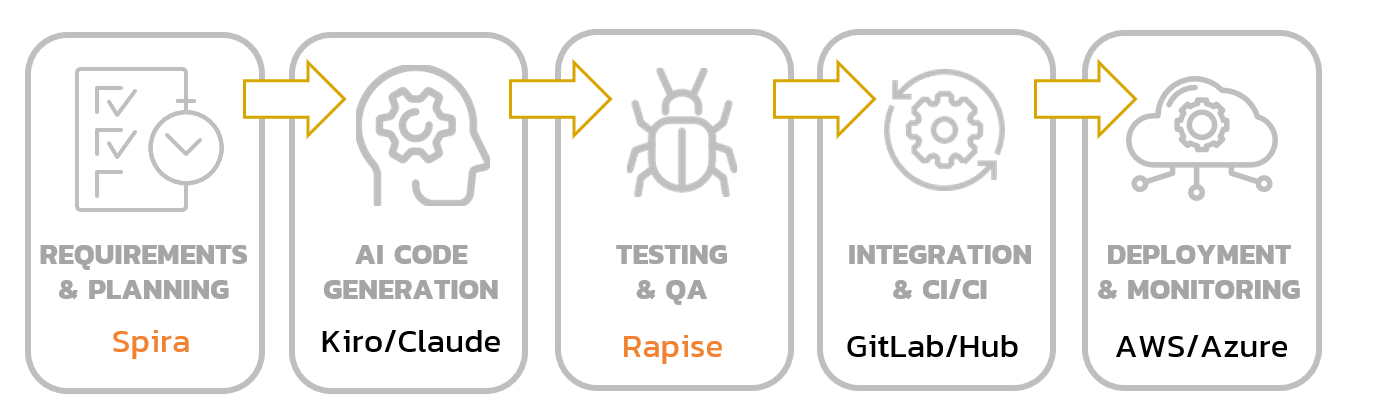
During the Create phase, AI coding agents operating through harnesses such as Claude Code, Amazon Kiro, or OpenAI Codex perform the actual software development, while Spira remains the authoritative source of requirements, priorities, tasks, and acceptance criteria. Through MCP, coding agents can retrieve their assigned specifications, understand dependencies and related requirements, consult existing defects and risks, and maintain traceability between the work being performed and its business justification.
As implementation progresses, agents can report status, identify blockers, propose changes, and update relevant lifecycle artifacts in Spira. Inflectra.ai could continuously examine this feedback, identify deviations from the original specification, recommend additional work, and flag emerging risks or inconsistencies that require attention. Rather than allowing autonomous coding agents to operate as isolated development environments, Spira provides the shared context and governance needed to keep implementation aligned with the organization's objectives.
5. Verify: Risk-Based Continuous Quality Assurance
In the Verify phase, Spira becomes the central intelligence and governance hub for determining what needs to be tested, how thoroughly it must be tested, and whether sufficient evidence exists to establish confidence in the software. By maintaining the relationships between requirements, test cases, defects, releases, and risks, Spira provides the foundation for risk-based test selection and coverage analysis. Inflectra.ai can analyze requirements and existing test coverage to identify missing scenarios, recommend additional tests, highlight high-risk functionality, and help prioritize the most valuable verification activities.
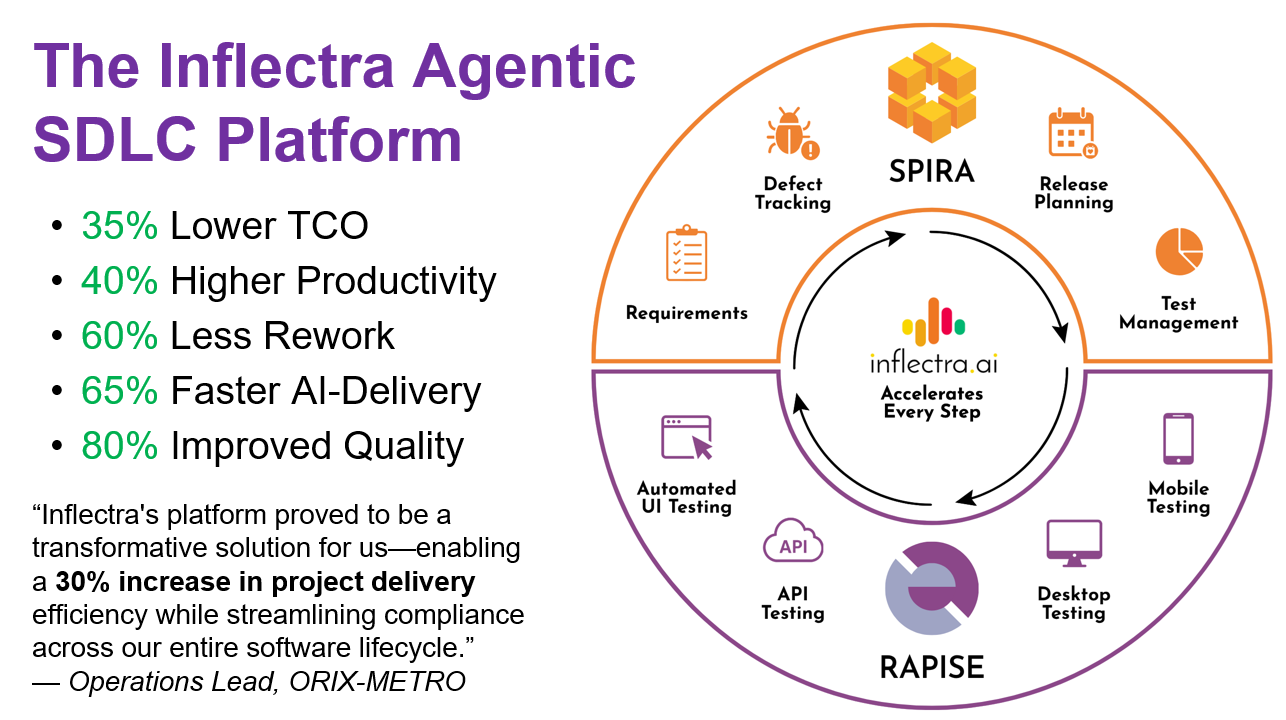
Specialized testing agents and automated testing platforms such as Rapise can then execute the appropriate functional, regression, integration, and end-to-end tests, returning results to Spira. Crucially, the factory could use predefined risk policies, coverage thresholds, test outcomes, and outstanding defect severity to determine whether adequate testing has been completed or whether additional verification is required before the software can proceed. Quality assurance therefore becomes an intelligent, continuous decision-making process rather than simply a measure of how many tests have been executed.
6. Deploy: Risk-Adaptive Deployment Governance
During deployment, Spira provides the governance framework for determining whether a software change is authorized to move into a target environment. Using the requirements, test results, outstanding defects, risk assessments, and release information maintained in Spira, Inflectra.ai could evaluate deployment readiness and identify unresolved issues or missing verification evidence.
The factory can then apply a risk-adaptive autonomy policy: low-risk changes that satisfy predefined criteria may be deployed automatically, medium-risk changes may require additional checks or human approval, and high-risk changes may demand formal review and explicit authorization. Deployment agents and CI/CD platforms can consult the relevant release policies through MCP or other integrations, perform the deployment once authorized, and report deployment results back to Spira. This creates a governed deployment process in which autonomous execution is permitted according to the risk of the change, rather than applying the same level of human intervention to every deployment.
7. Release: Establishing Confidence and Business Readiness
The Release phase goes beyond the technical deployment of software to determine whether the delivered functionality is ready for broader production use and achieves its intended business objectives. Spira acts as the authoritative repository for release scope, requirements completion, defect status, risk exposure, test evidence, and outstanding acceptance criteria, providing a consolidated view of release readiness.
Inflectra.ai can analyze these interconnected artifacts to produce release summaries, identify unresolved risks, assess the impact of outstanding defects, and highlight gaps between the original business requirements and the functionality delivered. Based on predefined release policies, the factory could determine whether a release can proceed autonomously, requires additional verification, or must be escalated for human review and approval.
By maintaining a complete traceability record from the original requirement through implementation, testing, and release, Spira helps organizations demonstrate not simply that software was delivered, but that it was delivered with an appropriate level of quality, assurance, and governance.
8. Monitor: Closing the Loop with Continuous Feedback
In the Monitor phase, Spira becomes the central repository for operational feedback, production incidents, emerging risks, and improvement opportunities, connecting real-world software behavior back to the original business requirements and quality objectives.
Monitoring and observability agents can detect application failures, performance degradation, security events, and unexpected behavior, using MCP or other integrations to create or update incidents and related lifecycle artifacts in Spira. Inflectra.ai could analyze this information alongside requirements, historical defects, previous test results, and risk assessments to identify recurring problems, recommend corrective actions, and determine whether additional tests or changes are necessary.
These findings can automatically feed back into the planning and specification stages, allowing the factory to refine its backlog, reprioritize work, and initiate new development activities. This closes the autonomous software development loop, transforming production monitoring from a largely reactive operational activity into a continuous source of intelligence that drives improvements in quality, reliability, and business outcomes.
The Inflectra Factory
The three systems (Spira, Rapise and Inflectra.ai) form a closed-loop architecture using MCP as the connective tissue, in which Spira maintains the authoritative context, Inflectra.ai provides intelligence, and Rapise performs automated validation. Test results and other evidence flow back into Spira, allowing the intelligence layer to reassess progress, quality, and risk.
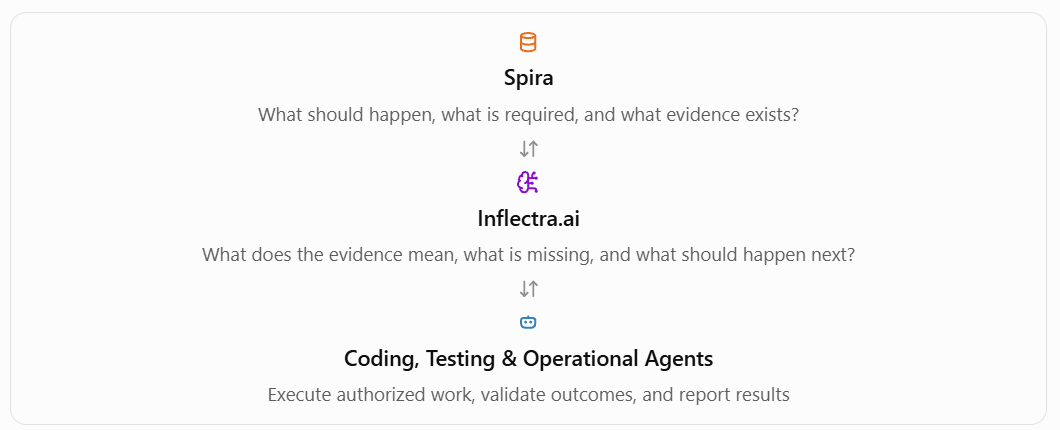
Beyond just the quality side of things, in this model, a coding agent does not simply retrieve a requirement and disappear until the implementation is complete. It checks back with Spira throughout its work. A testing agent does not independently decide that all testing is complete; it evaluates the evidence against the requirements, risks, and assurance policies maintained by the control plane. A deployment agent does not automatically deploy merely because a build succeeded; it checks whether the required authorization and quality criteria have been satisfied.
Using the Inflectra software factory, the future of software engineering is not simply autonomous code generation, but autonomous software delivery built on shared context, continuous assurance, and risk-based human governance.

However, there is one remaining aspect. If Inflectra.ai is verifying the quality of the products made by the software factory, how can we ensure the quality of “machinery” that makes up the factory itself.
Testing the Factory Machinery: From Testing with AI to Testing of AI
As we move toward the autonomous software factory described above, there is one critical question that is often overlooked: who tests the factory machinery itself? In traditional manufacturing, quality assurance involves not only inspecting the finished products but also regularly testing, calibrating, and validating the machines that produce them.
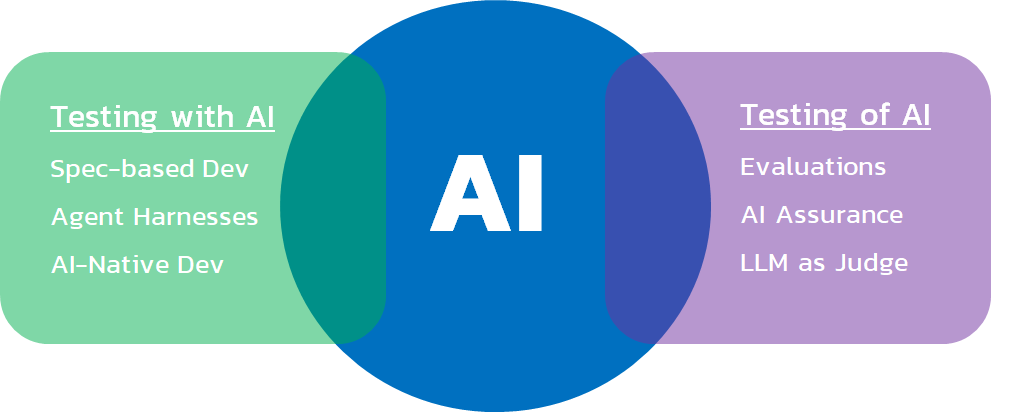
The same principle applies to the Agentic SDLC. While Testing with AI uses intelligent agents and tools such as Inflectra.ai and Rapise to validate the software being produced, Testing of AI focuses on evaluating the AI agents that operate the factory itself. After all, if autonomous agents are responsible for interpreting requirements, writing code, executing tests, and making deployment decisions, how can we be confident that those agents are reliable, secure, and behaving as intended? The factory cannot be truly autonomous and trustworthy unless the machinery powering it is also continuously tested and assured.
This is where SureWire.ai, Inflectra's AI assurance platform, becomes an essential part of the autonomous software factory. SureWire is designed to test and evaluate AI agents and AI-powered systems by challenging them with realistic scenarios, unexpected inputs, adversarial attacks, and policy compliance checks to identify unsafe, unreliable, or unintended behavior.
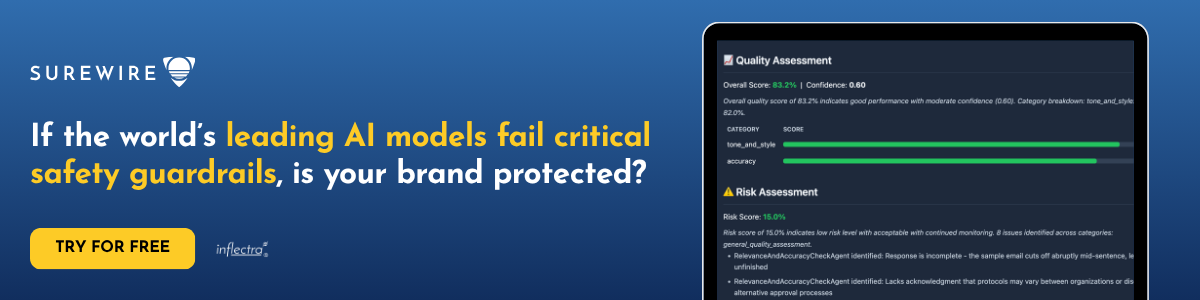
Unlike traditional software testing, which typically validates deterministic outputs against predefined expectations, SureWire examines how AI agents reason, respond, and behave across varied and potentially unpredictable situations. By combining SureWire's Testing of AI capabilities with the Testing with AI capabilities of Inflectra.ai, Spira, and Rapise, organizations can establish two complementary layers of Continuous Quality Assurance: one that verifies the software produced by the factory, and another that validates the AI machinery responsible for producing it.
In the Autonomous Software Factory, we must not only trust the products coming off the production line; we must continuously verify the intelligence operating the production line itself.